
Three Victorian Portraits from the Smyth Family
A small photographic archive linking the Beardmore, Smyth, Denham and Batteson families across Victorian and Edwardian England
In May 2026 I acquired three original nineteenth-century photographic portraits relating to the Smyth family, together with later handwritten identifications on the reverse of the cards. What initially appeared to be a small group of ordinary Victorian cartes-de-visite rapidly developed into a much larger and unexpectedly detailed family reconstruction involving London, Nottinghamshire, Derbyshire, East London, and eventually the industrial communities of Tottenham and Edmonton.
The three photographs depict:
- Henry Smyth (1817–1873)
- Charlotte Louisa Smyth née Beardmore (1818–1884)
- Harry Denham Smyth (1872–1945)
At first glance the photographs seem unrelated beyond the shared surname. However, research quickly established that they represent three generations of the same family:
Henry Smyth and Charlotte Louisa Beardmore were husband and wife.
Their son was:
Henry Beardmore Smyth (1847–1895).
And Harry Denham Smyth was their grandson.
The discovery transformed the photographs from isolated portraits into part of a much wider surviving family story.
The Portrait of Henry Smyth
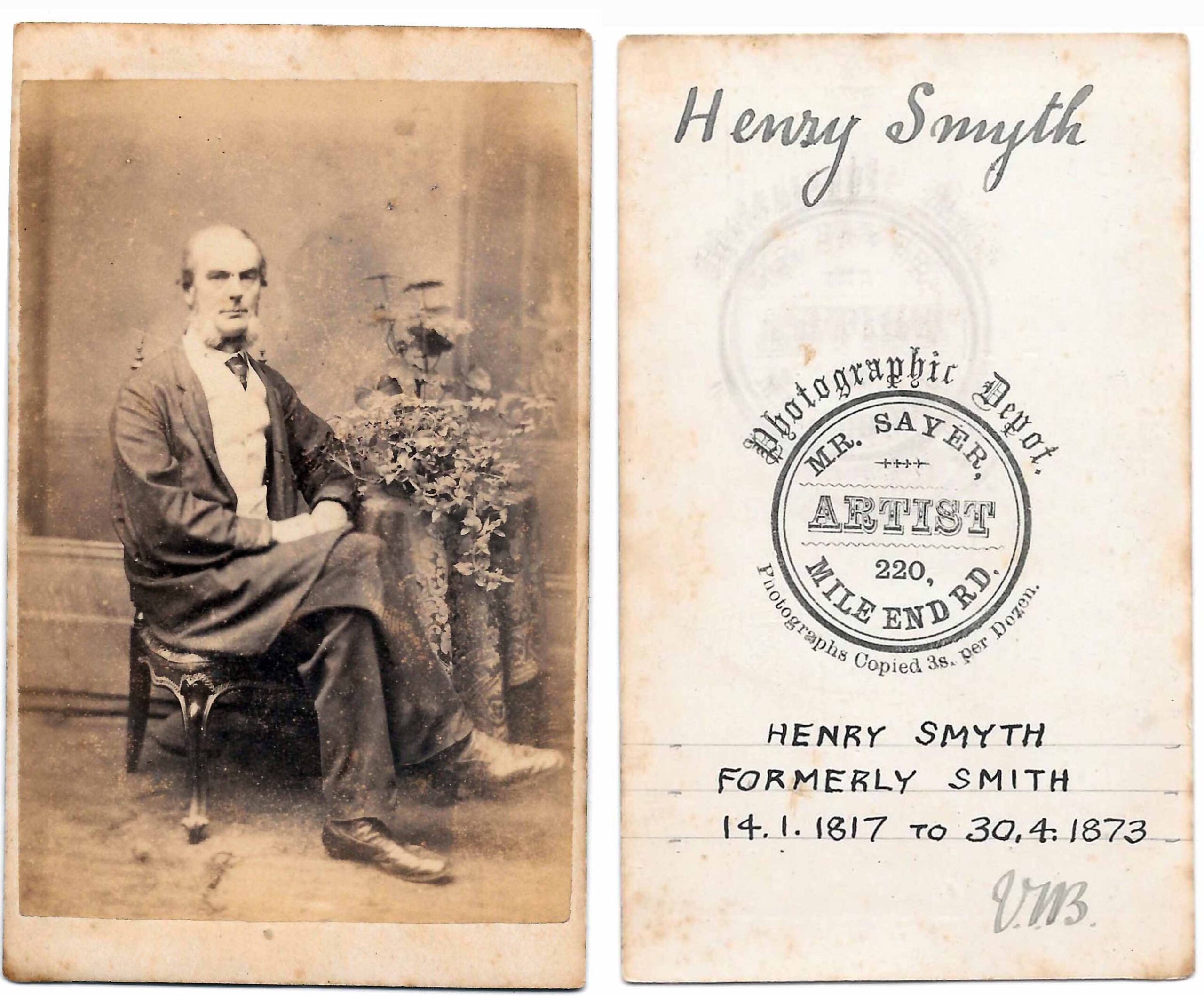 The earliest portrait in the group depicts:
Henry Smyth
born 14 January 1817
died 30 April 1873
The reverse of the photograph identifies him as:
“Henry Smyth formerly Smith”
This small annotation proved to be one of the most important discoveries connected with the archive.
Further research established that Henry was the son of:
- Johann Schmidt
- Hannah Grainger
The family therefore appears to have undergone a gradual surname transformation:
Schmidt → Smith → Smyth
Whether this reflected social aspiration, anglicisation, assimilation into English society, or professional reinvention remains uncertain, but the deliberate preservation of the phrase “formerly Smith” suggests the transition was important to family identity.
Henry himself worked first as an:
Artist
before later becoming a:
Land Surveyor
By 1861 he was living at:
27 Newbold Road, Chesterfield
and an 1860 advertisement in the Derbyshire Times & Herald confirms his professional activity during the height of the Victorian industrial period.
Henry died on 30 April 1873 at:
19 British Street, Bromley, Middlesex
His death certificate records the cause as:
“Tumor on Throat”
The Portrait of Charlotte Louisa Smyth née Beardmore
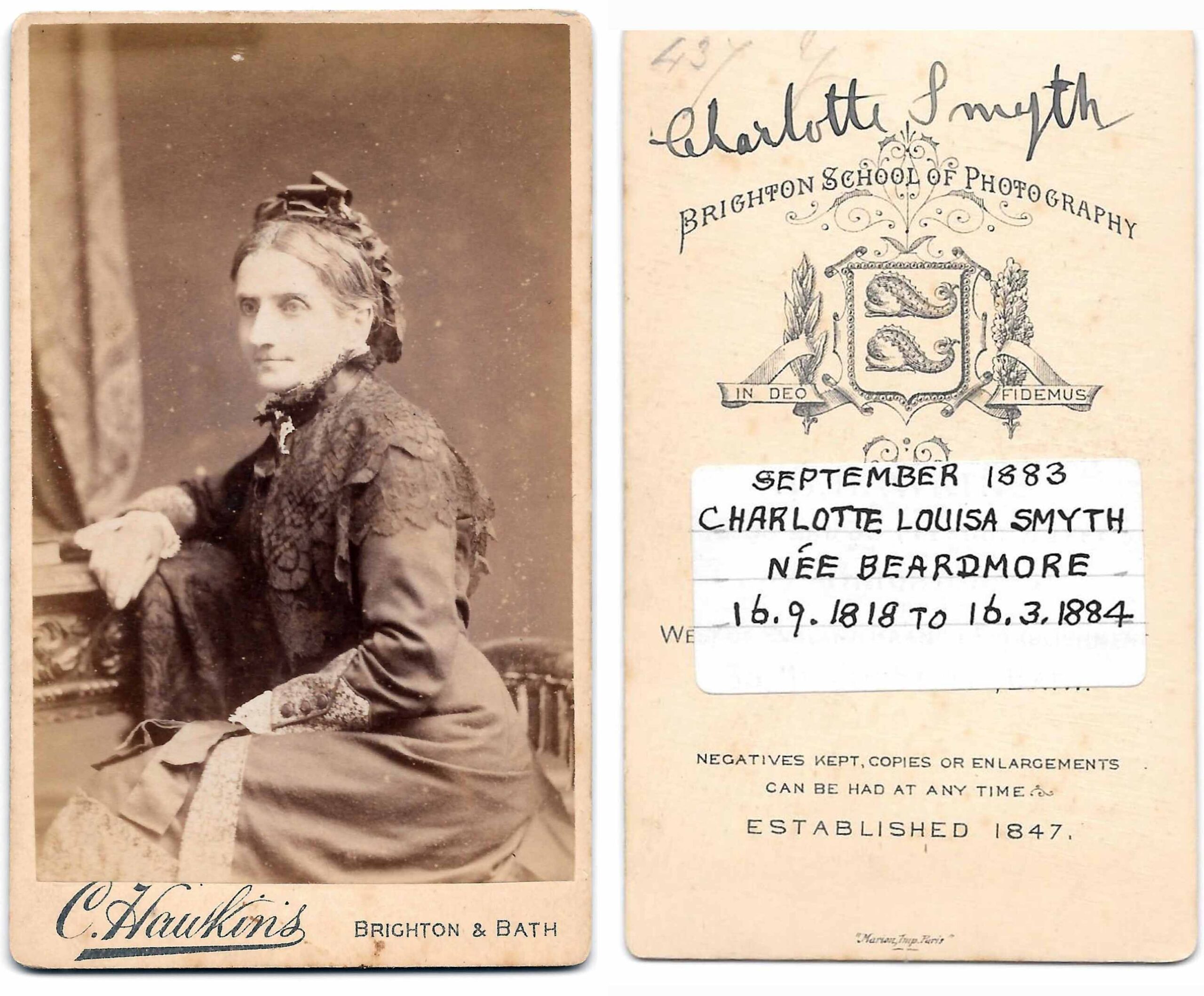 The second portrait depicts:
Charlotte Louisa Smyth née Beardmore
born 16 September 1818
died 16 March 1884
Charlotte was born at Radford, Nottinghamshire, the daughter of:
- George Beardmore (1784–1854)
- Susannah Elizabeth Trapps (1786–1847)
She married Henry Smyth at Chesterfield Parish Church on 9 April 1844.
The couple had two surviving children:
- Louisa Elizabeth Smyth (1845–1917)
- Henry Beardmore Smyth (1847–1895)
The portrait itself is especially poignant because the reverse is dated:
September 1883
Charlotte died only six months later.
The photograph therefore appears to be one of the final formal portraits taken during her lifetime.
By this stage Charlotte had already outlived:
- her parents
- multiple siblings
- and her husband Henry.
The intensity of the portrait becomes much more striking when viewed within this context.
The photograph was taken by:
C. Hawkins, Brighton & Bath
and survives today in unusually good condition for a carte-de-visite of the period.
The Portrait of Harry Denham Smyth
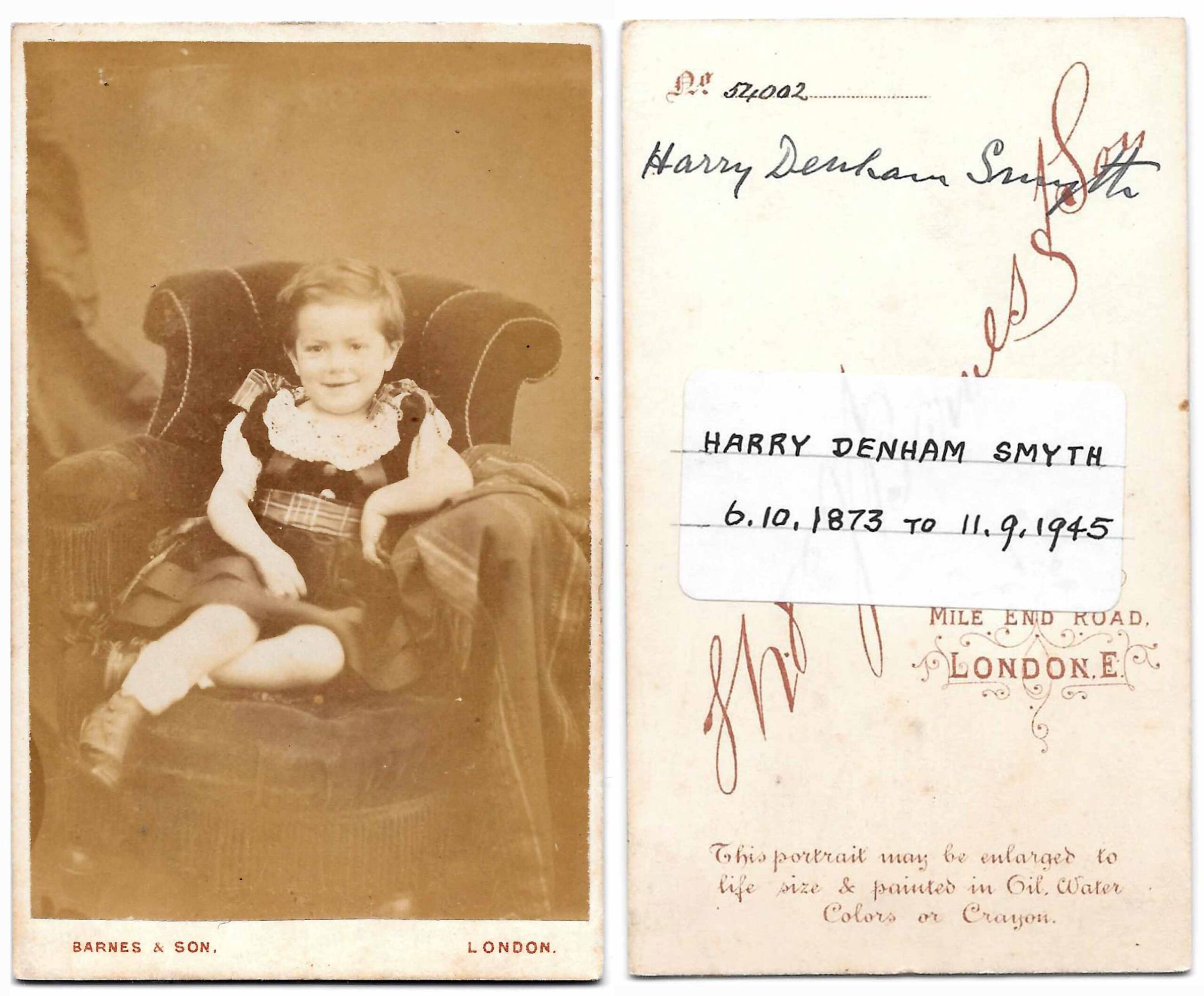 The third photograph depicts:
Harry Denham Smyth
born 6 October 1872
died 11 September 1945
Harry was the grandson of Henry and Charlotte Smyth.
Born at:
16 Cadogan Terrace, South Hackney
he was the son of:
- Henry Beardmore Smyth (1847–1895)
- Ellen Denham (1845–1914)
The portrait appears to date from the mid-to-late 1870s when Harry was a very young child.
The photograph survives with a later handwritten identification on the reverse and was taken by:
Barnes & Son, London
Harry’s later life reflects the family’s transition into the industrial twentieth century.
By 1911 his occupation was recorded as:
Packer of Electric Lamps
and later:
Stock Keeper, Electric Lamp Stores, GEC
His working life therefore connected the family directly to the rapid electrification of London during the early twentieth century.
Harry married:
Minnie Lavinia Hackett
in 1901 and had five children.
The later years of his life were marked by repeated losses, including the deaths of:
- his young son Henry James Denham Smyth in 1920
- his wife Minnie in 1928
- and his son Leslie Horace Smyth later the same year.
A Family Across Victorian and Edwardian England
Although only three photographs have so far been acquired, the research surrounding them has already revealed a much wider family history stretching across more than a century.
The archive now connects:
- German and English family origins
- Victorian surname transformation
- Nottinghamshire and Derbyshire family networks
- East London migration
- professional Victorian surveying work
- portrait photography culture
- and industrial employment within twentieth-century London.
Perhaps most importantly, the photographs preserve the continuity of one family across three generations:
grandparents,
their children,
and their grandchildren.
Research into the Smyth family remains ongoing and future work will include:
- newspaper investigations
- probate records
- trade directories
- surveying advertisements
- electoral registers
- cemetery records
- and further reconstruction of the wider Beardmore, Denham and Batteson families.
Research and reconstruction by Ian Waugh.
Part of the ianwaugh.com archive collections.