Wycombe Abbey, India, Clifton, Eltham and the Private Language of a 20th-Century Family
A handwritten family memoir centred on Kate Coleman Ryves, Alfred Ernest Ryves, Dr Tom Ryves and their wider family circle, preserving memories of India, Clifton, Oxford, Eltham, Wycombe Abbey, wartime displacement, domestic life, family language, poems, games, animals and photographs from the 1930s.
This archive preserves a handwritten family memoir connected with the Ryves family and headed on the original school book as Wycombe Abbey School, with the subject identified as the “Ryves Family”. The principal narrative begins with Kate Coleman Ryves, born in 1867 and died on 18 June 1957 aged 90, and expands into a richly detailed account of family memory across several generations.
The memoir is not a formal autobiography. It is more intimate than that. It records what one family remembered about itself: education, marriage, illness, bereavement, India, Oxford, Clifton, Eltham, Wycombe Abbey, wartime disruption, household moves, gardens, games, animals, private jokes, family sayings and remembered songs. Its value lies precisely in that mixture. It preserves not only dates and relationships, but the emotional texture of a family’s life.
Scope of the collection
The collection consists of a handwritten memoir in a school exercise book, a small number of loose note sheets, and associated family photographs. The manuscript moves from the Davies, Coleman, Price and Ryves families into later generations connected with Tom Ryves, Delia, Kit, Margaret and others. The memoir also includes recollections of India, the legal and medical professions, school and university life, domestic service, war, retirement, family houses, pets, games and private family vocabulary.
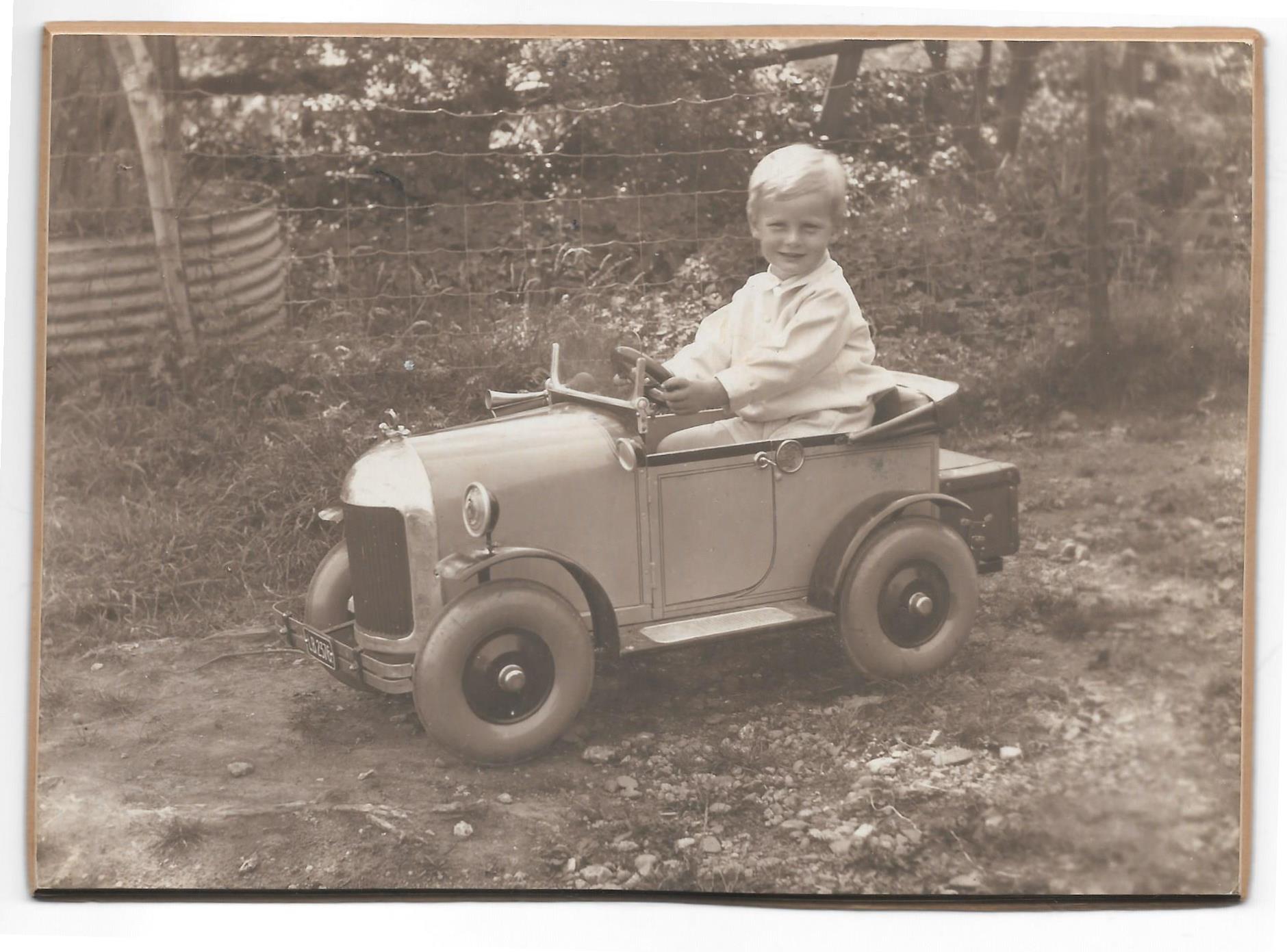
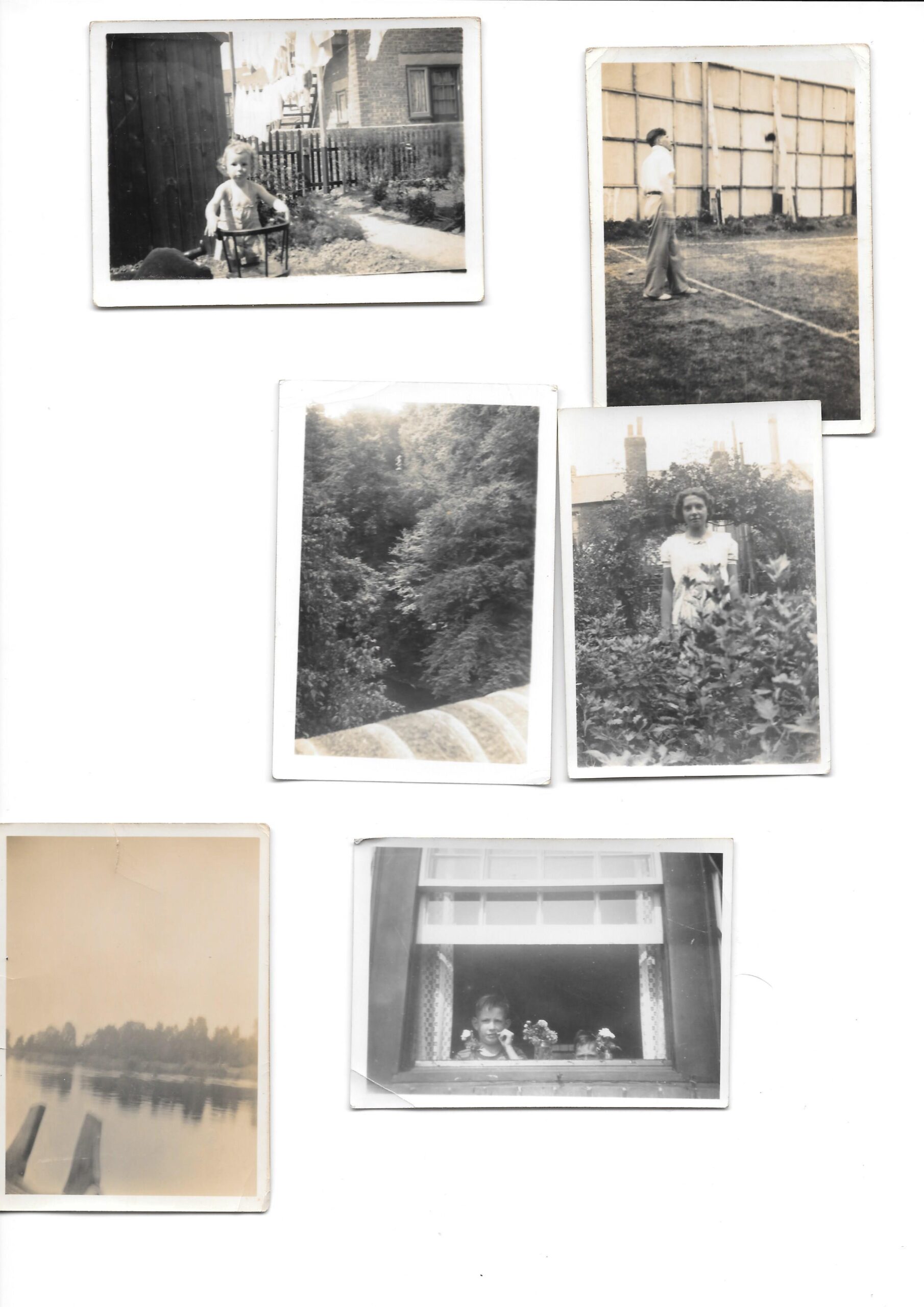
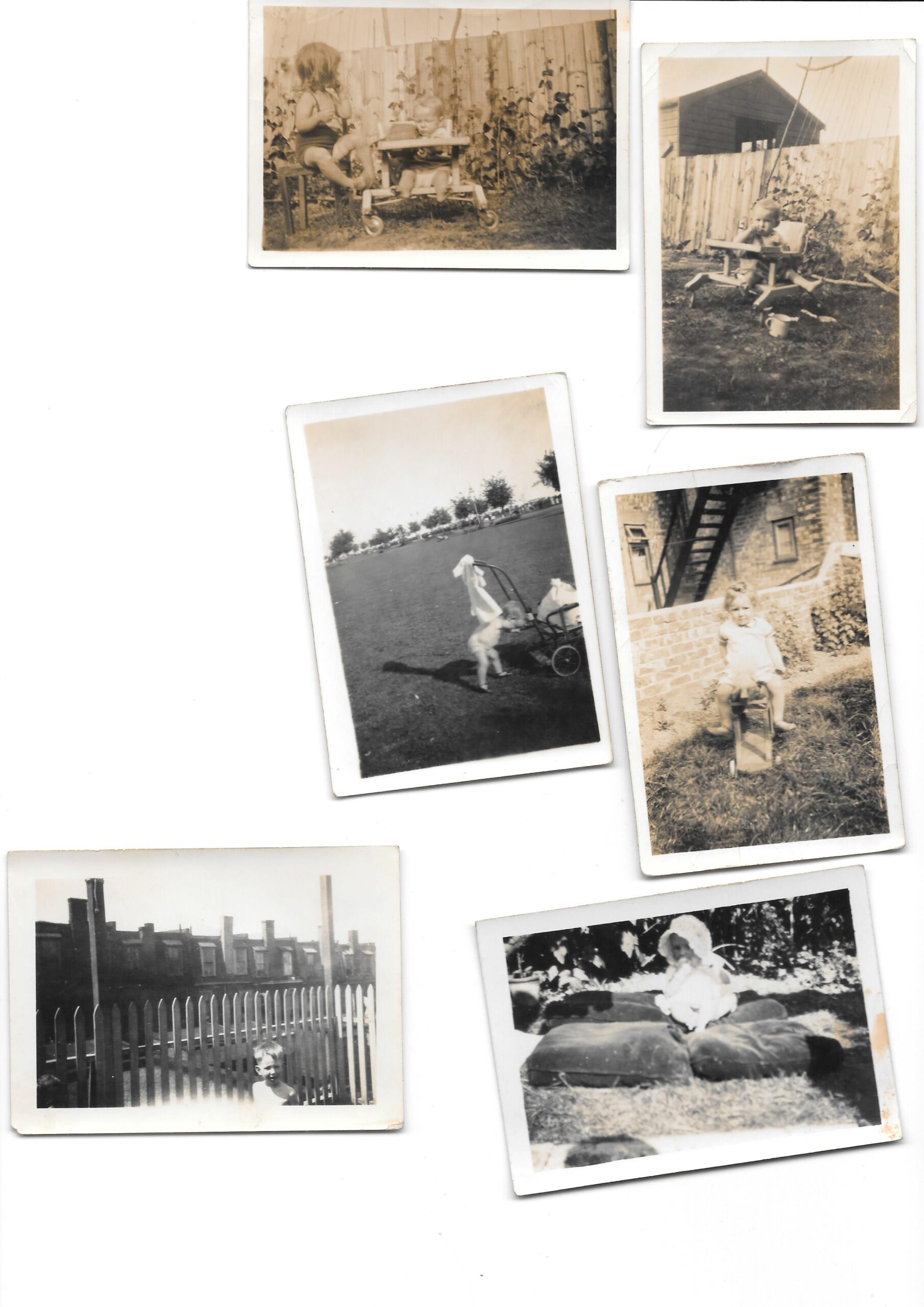
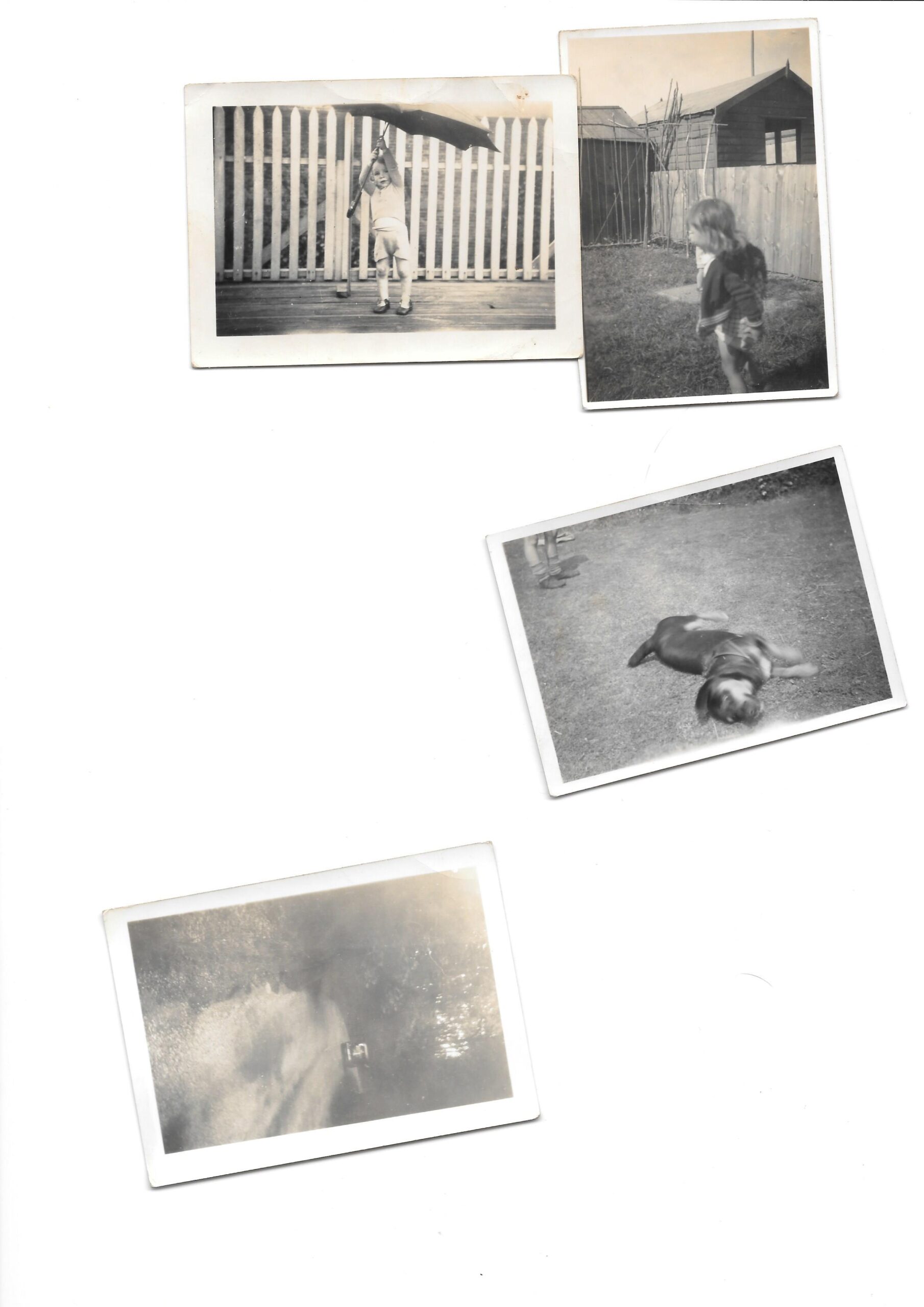
The accompanying photographs, probably dating from the later 1930s, show children, gardens, informal family scenes, toys, domestic settings and outdoor play. They are not formal studio portraits, but everyday family snapshots. As such, they give a visual counterpart to the memoir’s world of gardens, houses, childhood, affectionate routine and domestic humour.
Kate Coleman Ryves and the family memory
The memoir opens with Kate Coleman Ryves, née Davies. The writer recalls knowing relatively little about Kate’s father, except that he was Welsh, a clergyman, educated at Clare College, Cambridge, and remembered for a fine tenor voice. Kate’s mother belonged to the Coleman family, and the manuscript places part of Kate’s childhood memory at Longhope in Gloucestershire. The name “Longhope” later became important enough to be used for Kate’s own house at Great Missenden.
The early pages are especially valuable because they show how family memory was organised around houses. Longhope, Inveravon, Richmond Park Road in Clifton, Great Missenden, Eltham Road, Salsbury Road and other homes are not merely addresses. They are remembered as centres of family identity, care, education and refuge. “Inveravon” in Clifton becomes one of the emotional centres of the memoir: a place where children were brought up, relatives gathered, visitors stayed, and family continuity was maintained.
India, law, service and empire
A major part of the memoir concerns Alfred Ernest Ryves, remembered as “Dad”. He is described as educated at Clifton College and Trinity College, Oxford, before becoming a barrister. The manuscript connects the Ryves family with India over several generations, including memories of the Indian Mutiny, the Indian Police, legal practice in Calcutta and Allahabad, and later judicial service.
These passages must be read with care. They are family recollections, not official records, and they reflect the language and assumptions of their time. Nevertheless, they are historically significant because they show how imperial service was remembered within a British family: through stories of danger, professional honour, personal bravery, financial insecurity, household life, and the long emotional separation of parents and children.
Alfred Ernest Ryves is presented as a highly able barrister and judge, admired for his judgments, integrity and refusal to be bribed. The memoir repeatedly stresses his clarity of mind, legal ability, sporting interests and personal charm. It also records the financial blow suffered when a trusted associate mishandled or absconded with his assets after retirement, an event that deeply affected the family’s later circumstances.
Tom Ryves: doctor, sportsman, husband and father
The memoir then moves into the life of Tom Ryves. Educated first at Heddon Court and later at Charterhouse, he went on to Trinity College, Oxford, served in the Royal Artillery during the First World War, and suffered lasting mental effects from his wartime experiences. After the war he studied medicine, trained at Bart’s, and entered medical practice.
Tom’s professional life is described with affection but also realism. His Lee practice was financially difficult at first, especially during the Depression and later during the upheaval caused by the Second World War and the creation of the National Health Service. The memoir records periods of locum work, damaged housing, changing patient lists, professional struggle and eventual stability.
What emerges most strongly is the portrait of a doctor of the old personal kind: careful, thorough, deeply loved by patients, and remembered by colleagues and families alike. The writer records that some patients had been with him for more than forty years, and that after his death she received many affectionate letters from those he had treated.
War, displacement and domestic resilience
The memoir covers both world wars, but its strongest wartime passages relate to their effects on family life. During the First World War, Tom’s service in France left him marked for life. During the Second World War, the family experienced evacuation, professional disruption, damaged property, financial strain, and the need to rebuild domestic stability.
Yet the account is not only one of hardship. It repeatedly shows the household as a place of refuge. At different times the family housed relatives, students, friends, refugees from Nazi tyranny, people recovering from breakdowns or operations, and lodgers who became part of the household story. This gives the collection an unusually rich social dimension: it is not simply one family’s private memoir, but a record of how one household functioned as a small network of support.
Wycombe Abbey and Margaret
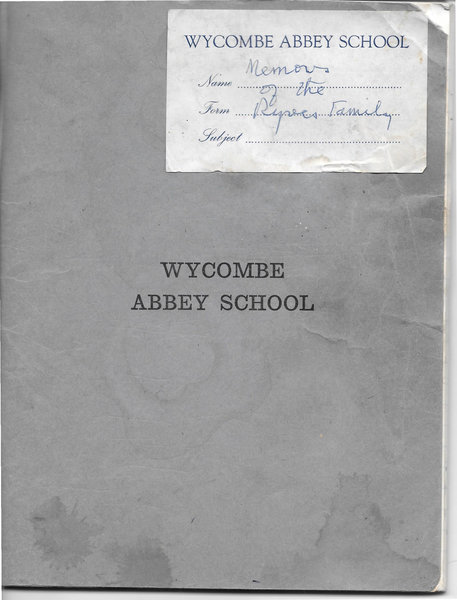
The Wycombe Abbey connection appears most clearly through Margaret, who taught Classics at Wycombe Abbey and drove daily from Kingston. The exercise book itself bears a Wycombe Abbey School cover label, suggesting that the memoir was written or preserved in a school exercise book connected with her. This gives the archive its institutional link, though the manuscript itself is primarily a family memoir rather than a school record.
Margaret is described with great affection. Her presence in the later part of the memoir is important: she becomes part of the household’s final years, supporting Tom and the writer, and helping to give shape and comfort to their later domestic life.
Private language, jokes and household memory
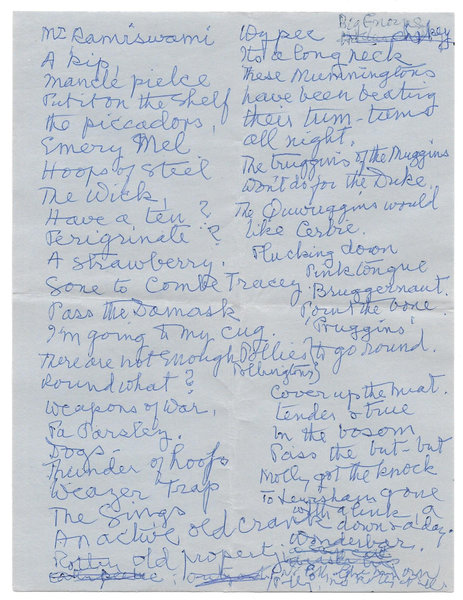
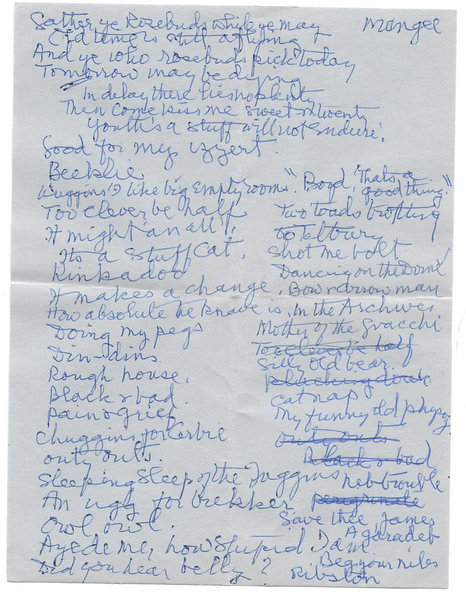
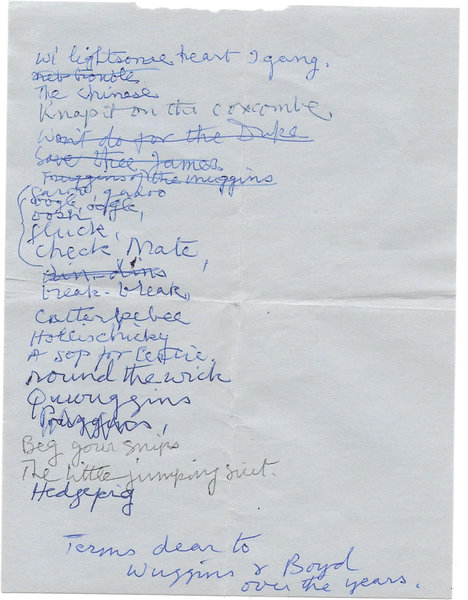
One of the most unusual parts of the archive is the loose note material. These sheets preserve private family expressions, nonsense words, pet names, comic sayings, fragments of songs, quotations and mnemonic phrases. Some are difficult or impossible to interpret fully without family context, but their survival is important.
Such material rarely enters formal archives. Families often have their own comic language, built from children’s speech, mishearings, repeated jokes, literary quotations, pet names, animal names and household incidents. In this collection, that private language includes references to “Muggins”, “Truggins”, “Pipchin”, “thunder of hoofs”, “round the wick”, “rotten old property”, “Save thee James”, “Pass the Damask” and many other phrases. These are not incidental scraps. They are evidence of the sound and humour of family life.
Poems and literary play
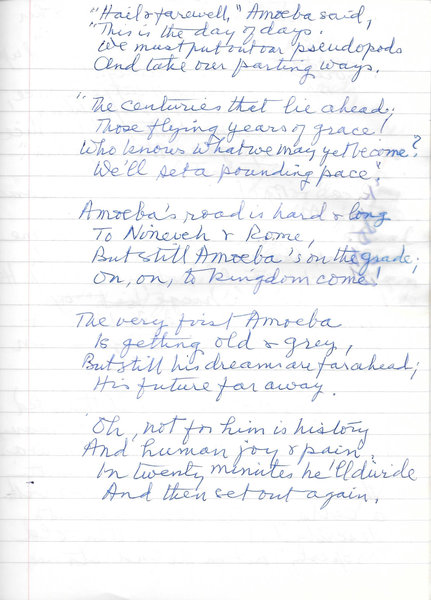
The manuscript also preserves poems and comic verse, including the “Amoeba” poem published in Punch on 23 July 1947. The verse is playful, scientific, humorous and domestic in tone, and sits naturally beside the family’s love of games, wordplay, counting, private jokes and affectionate nonsense.
The memoir also records songs sung to children, family verses, invented rhymes and performance-like household moments. These details make the archive especially valuable as evidence of educated domestic culture in the first half of the twentieth century.
Photographs
The photographs associated with the manuscript appear to date mainly from the later 1930s. They show children in gardens, a child in a toy motor car, prams, garden play, family snapshots, outdoor settings, fences, domestic buildings and informal scenes. They do not appear to be professional portraits. Their importance lies in their ordinariness: they show the daily world behind the written memoir.
Together, the photographs and manuscript create a fuller archive than either would alone. The memoir supplies memory, names, tone and family relationships. The photographs supply setting, atmosphere and visual evidence of domestic life.
Historical value
This collection is valuable for several reasons. It records one family’s memory across several generations; it links Britain, India, Clifton, Oxford, Eltham, Great Missenden, Kingston and Wycombe Abbey; it preserves the lived effects of war, retirement, professional life and family care; and it captures the informal language of a household in a way that formal records almost never do.
It should not be treated as a complete or fully verified genealogy. Some statements are clearly based on memory, family story and personal impression. Names, dates and events should be checked against civil registration records, census returns, probate records, school registers, university records, legal directories, medical registers and India Office material where possible. But as a primary family memoir, it is rich, vivid and unusually revealing.
Editorial note
The transcription presented here preserves the wording and tone of the original manuscript as closely as possible. Spelling, punctuation and capitalisation have generally been retained. Unclear words are marked where necessary. The manuscript includes period language and attitudes, particularly in relation to India and imperial service, which are preserved as part of the historical record.
This archive is therefore both a family document and a social document: a record of memory, affection, class, empire, education, medicine, domestic resilience, humour and loss.
The Wycombe School Book
WYCOMBE ABBEY SCHOOL
Label:
WYCOMBE ABBEY SCHOOL
Name: Memoirs of the
Form: Ryves Family
Subject: [blank]
Printed on cover:
WYCOMBE ABBEY SCHOOL
Photograph caption
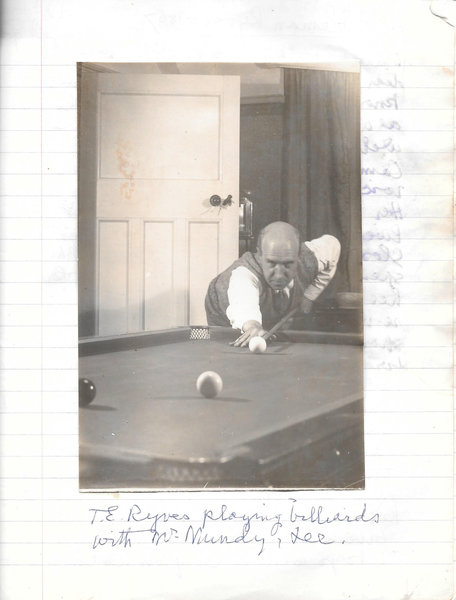
T. E. Ryves playing billiards with Mr Mundy, Lee.
Editorial note: This appears to be a pasted photograph of an elderly man playing billiards, captioned by hand beneath the image.
Page 1
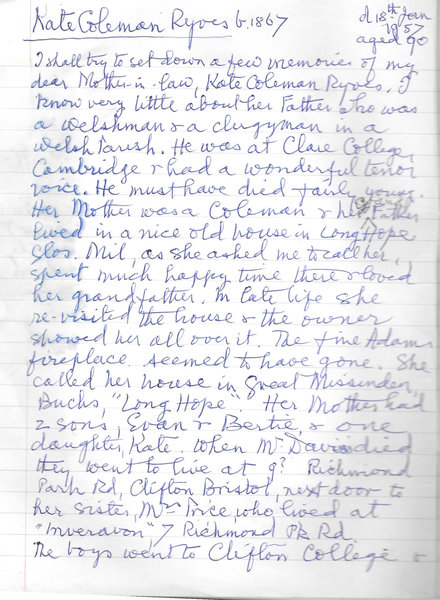
Kate Coleman Ryves b. 1867 d 18th June 1957 aged 90
I shall try to set down a few memories of my dear Mother-in-law, Kate Coleman Ryves. I know very little about her Father. He was a Welshman & a clergyman in a Welsh parish. He was at Clare College Cambridge & had a wonderful tenor voice. He must have died fairly young. Her Mother was a Coleman & her Father lived in a nice old house in Longhope, Glos. Mil, as she asked me to call her, spent much happy time there & loved her grandfather. In late life she re-visited the house & the owner showed her all over it. The fine Adam fireplace seemed to have gone. She called her house in Great Missenden, Bucks, “Long Hope”. Her Mother had 2 sons, Evan & Bertie, & one daughter, Kate. When Mr Davies died they went to live at 9? Richmond Park Rd, Clifton Bristol, next door to her sister, Mrs Price, who lived at “Inveravon”, 7 Richmond Pk Rd.
The boys went to Clifton College
Page 2
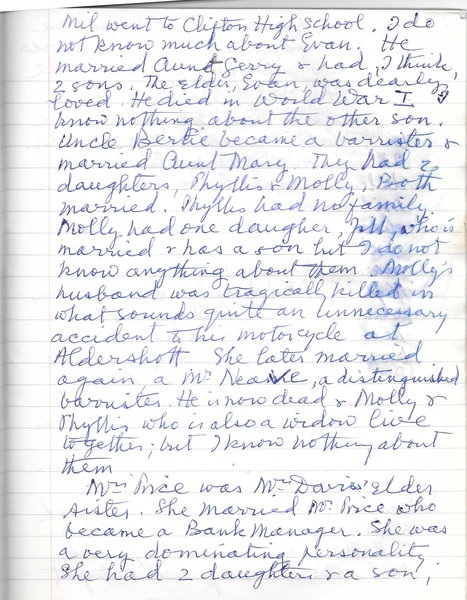
Mil went to Clifton High School. I do not know much about Evan. He married Aunt Gerry & had, I think, 2 sons. The elder, Evan, was dearly loved. He died in World War I. I know nothing about the other son.
Uncle Bertie became a barrister & married Aunt Mary. They had 2 daughters, Phyllis & Molly. Both married. Phyllis had no family. Molly had one daughter, Jill, who is married & has a son but I do not know anything about them. Molly’s husband was tragically killed in what sounds quite an unnecessary accident to his motorcycle at Aldershot. She later married again a Mr Neave, a distinguished barrister. He is now dead & Molly & Phyllis who is also a widow live together, but I know nothing about them.
Mrs Price was Mr Davies’s elder sister. She married Mr Price who became a Bank Manager. She was a very dominating personality. She had 2 daughters & a son,
Page 3
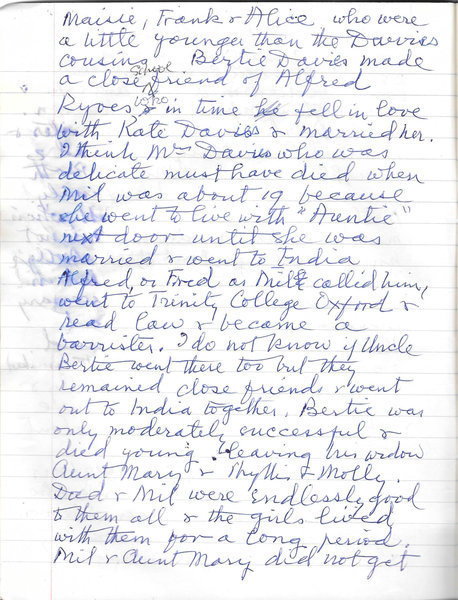
Maisie, Frank & Alice, who were a little younger than the Davies cousins. Bertie Davies made a close friend of Alfred Ryves who in time fell in love with Kate Davies & married her.
I think Mrs Davies who was delicate must have died when Mil was about 19 because she went to live with “Auntie” next door until she was married & went to India.
Alfred, or Fred as Mil called him, went to Trinity College Oxford & read law & became a barrister. I do not know if Uncle Bertie went there too but they remained close friends & went out to India together. Bertie was only moderately successful & died young leaving his widow Aunt Mary & Phyllis & Molly.
Dad & Mil were endlessly good to them all & the girls lived with them for a long period. Mil & Aunt Mary did not get
Page 4
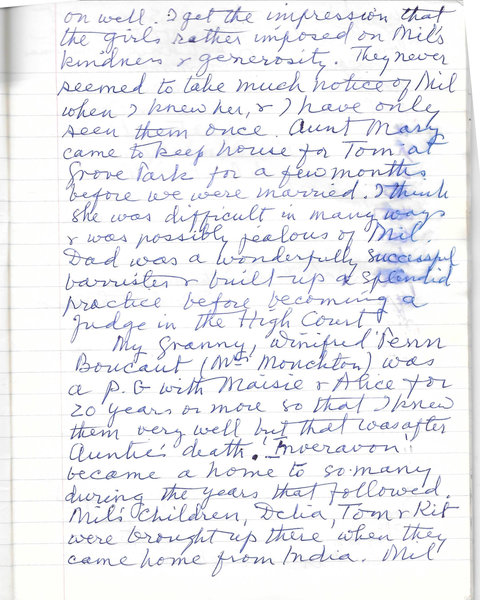
on well. I get the impression that the girls rather imposed on Mil’s kindness & generosity. They never seemed to take much notice of Mil when I knew her, & I have only seen them once. Aunt Mary came to keep house for Tom at Grove Park for a few months before we were married. I think she was difficult in many ways & was possibly jealous of Mil.
Dad was a wonderfully successful barrister & built up a splendid practice before becoming a judge in the High Court.
My Granny, Winifred Penn Boucaut (Mrs Monckton) was a P.G with Maisie & Alice for 20 years or more so that I knew them very well but that was after “Auntie’s” death. “Inveravon” became a home to so many during the years that followed. Mil’s children, Delia, Tom & Kit were brought up there when they came home from India. Mil
Page 5
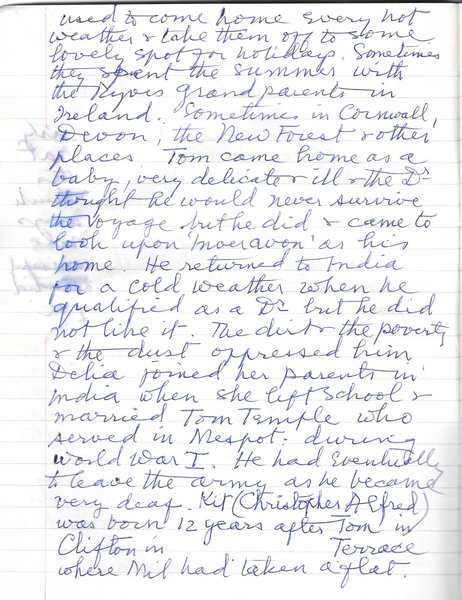
used to come home every hot weather & take them off to some lovely spot for holidays. Sometimes they spent the summers with the Ryves grandparents in Ireland. Sometimes in Cornwall, Devon, the New Forest & other places. Tom came home as a baby, very delicate & ill & the Dr thought he would never survive the voyage, but he did & came to look upon “Inveravon” as his home. He returned to India for a cold weather when he qualified as a Dr but he did not like it. The dirt & the poverty & the dust oppressed him.
Delia joined her parents in India when she left school & married Tom Temple who served in Mespot. during World War I. He had eventually to leave the army as he became very deaf. Kit (Christopher Alfred) was born 12 years after Tom in Clifton in Terrace where Mil had taken a flat.
Page 6
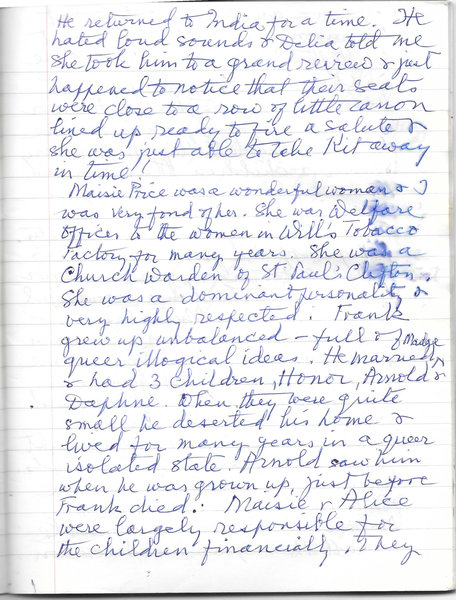
He returned to India for a time. He hated loud sounds & Delia told me she took him to a grand review & just happened to notice that their seats were close to a row of little cannon lined up ready to fire a salute & she was just able to take Kit away in time!
Maisie Price was a wonderful woman & I was very fond of her. She was Welfare Officer to the women in Wills’ Tobacco factory for many years. She was a Church Warden of St Paul’s Clifton. She was a dominant personality & very highly respected. Frank grew up unbalanced — full of strange queer illogical ideas. He married & had 3 children, Honor, Arnold & Daphne. When they were quite small he deserted his home & lived for many years in a queer isolated state. Arnold saw him when he was grown up, just before Frank died. Maisie & Alice were largely responsible for the children financially. They
Page 7
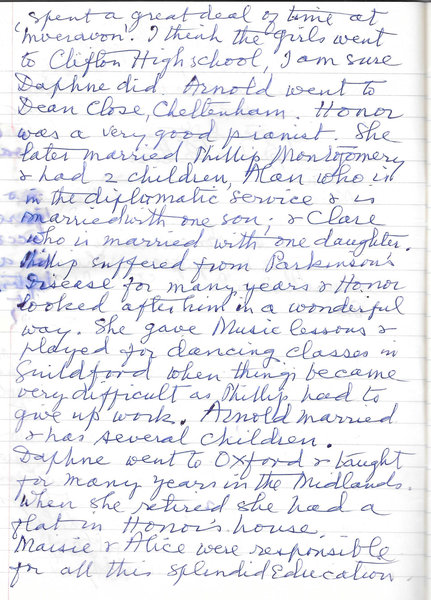
spent a great deal of time at “Inveravon”. I think the girls went to Clifton High School, I am sure Daphne did. Arnold went to Dean Close, Cheltenham. Honor was a very good pianist. She later married Phillip Montgomery & had 2 children, Alan who is in the diplomatic service & is married with one son, & Clare who is married with one daughter.
Phillip suffered from Parkinson’s Disease for many years & Honor looked after him in a wonderful way. She gave Music lessons & played for dancing classes in Guildford when things became very difficult as Phillip had to give up work. Arnold married & has several children. Daphne went to Oxford & taught for many years in the Midlands. When she retired she had a flat in Honor’s house.
Maisie & Alice were responsible for all this splendid education.
Page 8
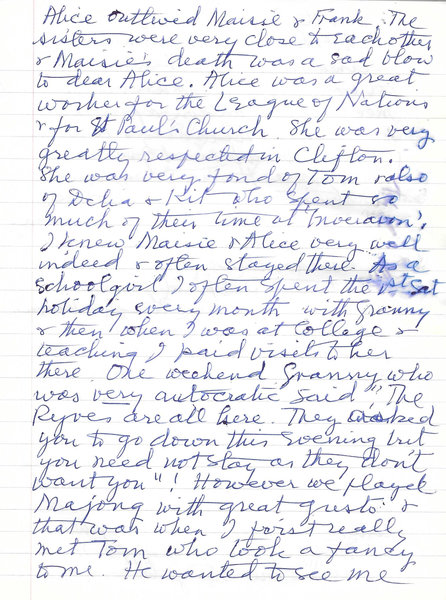
Alice outlived Maisie & Frank. The sisters were very close to each other & Maisie’s death was a sad blow to dear Alice. Alice was a great worker for the League of Nations & for St Paul’s Church. She was very greatly respected in Clifton. She was very fond of Tom & also of Delia & Kit who spent so much of their time at “Inveravon”.
I knew Maisie & Alice very well indeed & often stayed there. As a schoolgirl I often spent the first holiday every month with Granny & then when I was at college & teaching I paid visits to her there. One weekend Granny who was very autocratic said “The Ryves are all here. They asked you to go down this evening but you need not stay as they don’t want you”! However we played Mahjong with great gusto & that was when I first really met Tom who took a fancy to me. He wanted to see me
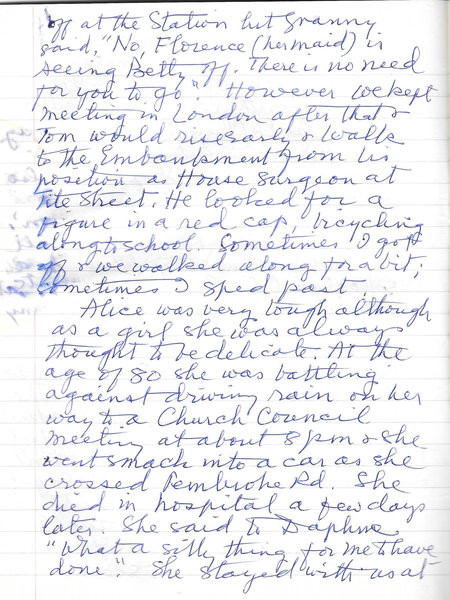
off at the Station but Granny said, “No, Florence (her maid) is seeing Betty off. There is no need for you to go.” However we kept meeting in London after that & Tom would rise early & walk to the Embankment from his position as House Surgeon at Kite Street. He looked for a figure in a red cap, bicycling along to school. Sometimes I got off & we walked along for a bit; sometimes I sped past.
Alice was very tough although as a girl she was always thought to be delicate. At the age of 80 she was battling against driving rain on her way to a Church Council meeting at about 8 pm & she went smack into a car as she crossed Pembroke Rd. She died in hospital a few days later. She said to Daphne, “What a silly thing for me to have done.” She stayed with us at
Page 10
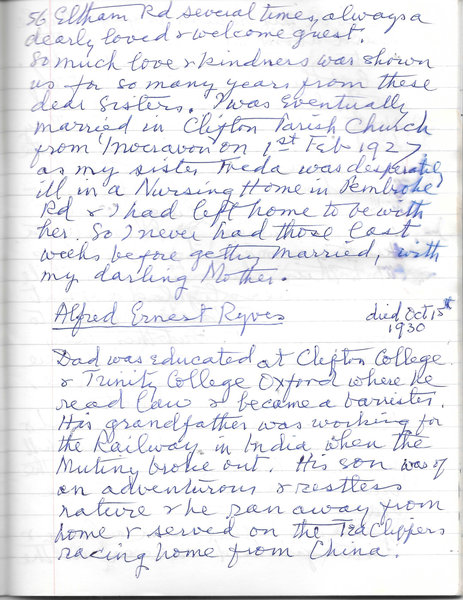
56 Eltham Rd several times, always a dearly loved & welcome guest. So much love & kindness was shown us for so many years from these dear sisters. I was eventually married in Clifton Parish Church from “Inveravon” on 1st Feb 1927 as my sister Freda was desperately ill in a Nursing Home in Pembroke Rd & I had left home to be with her. So I never had those last weeks before getting married, with my darling Mother.
Alfred Ernest Ryves died Oct 15th 1930
Dad was educated at Clifton College & Trinity College Oxford where he read law & became a barrister. His grandfather was working for the Railway in India when the Mutiny broke out. His son was of an adventurous & restless nature & he ran away from home & served on the Tea Clipper reading home from China.
Page 11
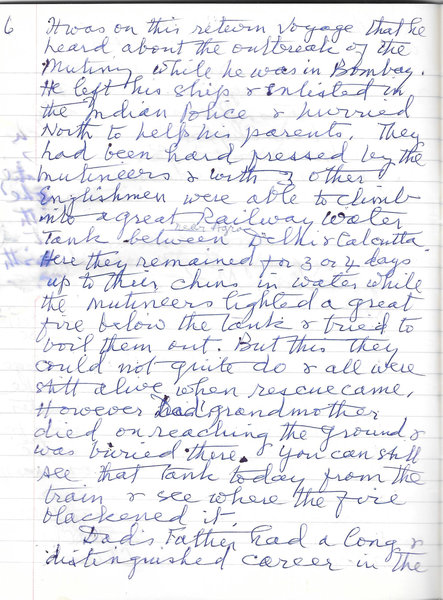
It was on this return voyage that he heard about the outbreak of the Mutiny, while he was in Bombay. He left his ship & enlisted in the Indian Police & hurried North to help his parents. They had been hard pressed by the mutineers & with 3 other Englishmen were able to climb into a great Railway water tank between Delhi & Calcutta. Here they remained for 3 or 4 days up to their chins in water while the mutineers lighted a great fire below the tank & tried to boil them out. But this they could not quite do & all were still alive when rescue came. However Dad’s grandmother died on reaching the ground & was buried there. You can still see that tank today from the train & see where the fire blackened it.
Dad’s Father had a long & distinguished career in the
Page 12
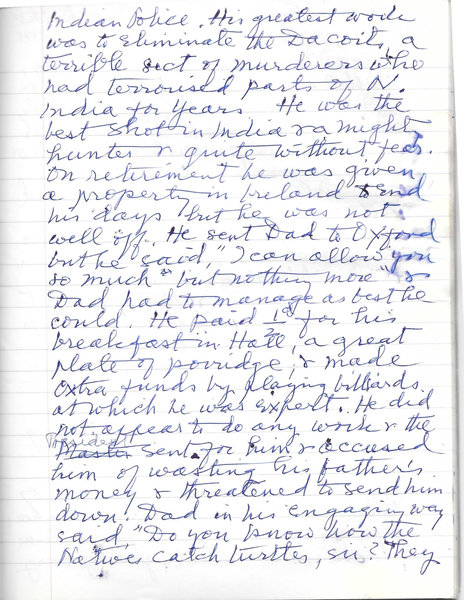
Indian Police. His greatest work was to eliminate the Dacoit, a terrible sect of murderers who had terrorised parts of N. India for years. He was the best shot in India & a mighty hunter & quite without fear. On retirement he was given a property in Ireland to end his days but he was not well off. He sent Dad to Oxford but he “said”, “I can allow you so much & but nothing more” & Dad had to manage as best he could. He paid 1/6 for his breakfast in Hall, a great plate of porridge, & made extra funds by playing billiards, at which he was expert. He did not appear to do any work & the Master sent for him & accused him of wasting his father’s money & threatened to send him down. Dad in his engaging way said “Do you know how the Natives catch turtles, sir? They
Page 13
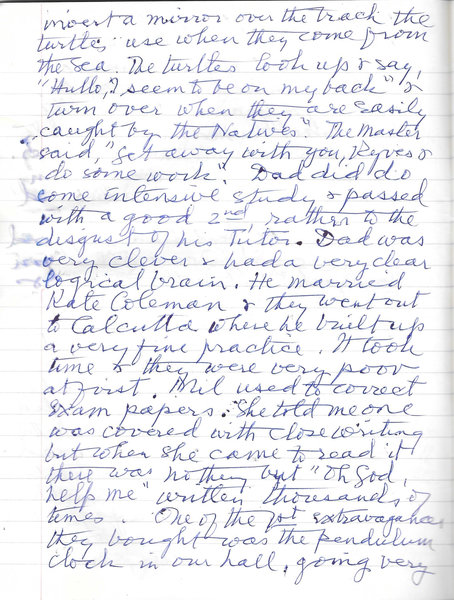
insert a mirror over the back the turtles use when they come from the sea. The turtles look up & say, ‘Hullo, I seem to be on my back,’ & turn over when they are easily caught by the Natives.” The Master said, “Get away with you, Ryves & do some work.” Dad did do intensive study & passed with a good 2nd rather to the disgust of his Tutor. Dad was very clever & had a very clear logical brain. He married Kate Coleman & they went out to Calcutta where he built up a very fine practice. It took time & they were very poor at first. Mil used to correct exam papers. She told me one was covered with close writing but when she came to read it there was nothing but “Oh God, help me” written thousands of times. One of the first extravagances they bought was the pendulum clock in our hall, going very
Page 14
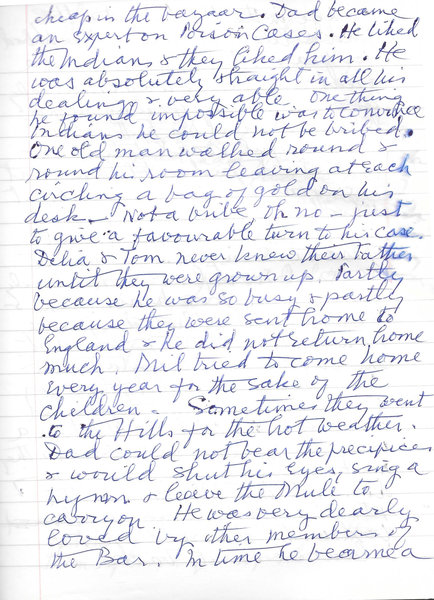
cheap in the bazaar. Dad became an expert on Bihar Cases. He liked the Indians & they liked him. He was absolutely straight in all his dealing & very able. One thing he found impossible was to convince Indians he could not be bribed. One old man walked round & round his room leaving at each circling a bag of gold on his desk — Not a bribe, oh no — just to give “a favourable turn to his case.” Delia & Tom never knew their father until they were grown up. Partly because he was so busy & partly because they were sent home to England & he did not return home much. Mil tried to come home every year for the sake of the children. Sometimes they went to the Hills for the hot weather. Dad could not bear the precipices & would shut his eyes, sing a hymn & leave the mule to carry on. He was very dearly loved by other members of the Bar. In time he became a
Page 15
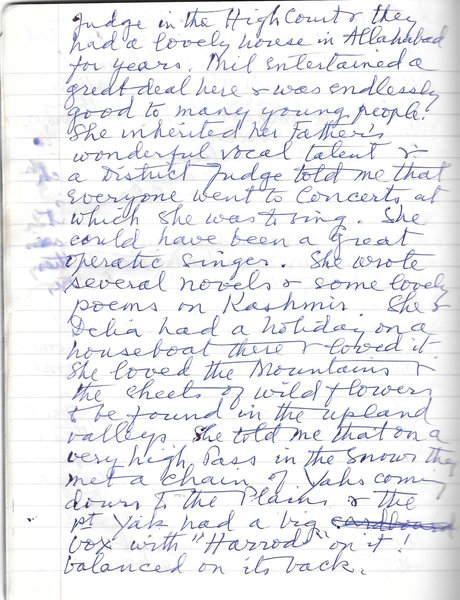
Judge in the High Court & they had a lovely house in Allahabad for years. Mil entertained a great deal there & was endlessly good to many young people. She inherited her father’s wonderful vocal talent & a District Judge told me that everyone went to concerts at which she was to sing. She could have been a great operatic singer. She wrote several novels & some lovely poems on Kashmir. She & Delia had a holiday on a houseboat there & loved it. She loved the mountains & the sheets of wild flowers to be found in the upland valley. She told me that on a very high pass in the snows they met a chain of Yaks coming down to the plains & the 1st Yak had a big [unclear/crossed-out word] box with “Harrods” on it! balanced on its back.
Page 16
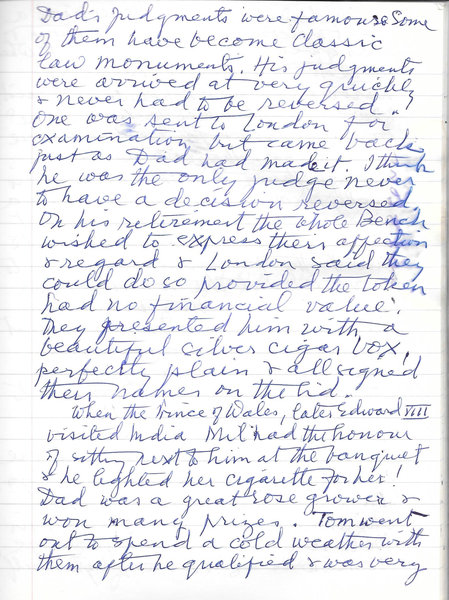
Dad’s judgments were famous. Some of them have become Classic Law Monument. His judgments were arrived at very quickly & never had to be reversed. One was sent to London for examination but came back just as Dad had made it. I think he was the only judge never to have a decision reversed. On his retirement the whole Bench wished to express their affection & regard & London said they could do so provided the token had no financial value. They presented him with a beautiful silver cigar box, perfectly plain & all signed their names on the lid.
When the Prince of Wales, later Edward VIII visited India Mil had the honour of sitting next to him at the banquet & he lighted her cigarette for her!
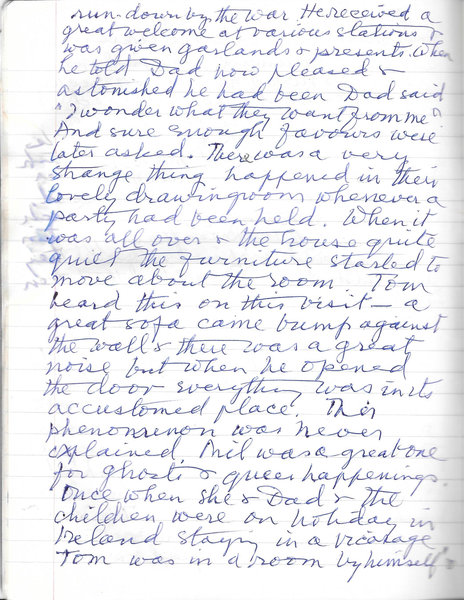
Dad was a great rose grower & won many prizes. Tom went out to spend a cold weather with them after he qualified & was very
Page 17
run down by the war. He received a great welcome at various stations & was given garlands & presents. When he told Dad how pleased & astonished he had been Dad said “I wonder what they want from me.” And sure enough favours were later asked. There was a very strange thing happened in their lovely drawingroom whenever a party had been held. When it was all over & the house quite quiet the furniture started to move about the room. Tom heard this on this visit — a great sofa came bump against the wall & there was a great noise but when he opened the door everything was in its accustomed place. This phenomenon was never explained. Mil was a great one for ghosts & queer happenings.
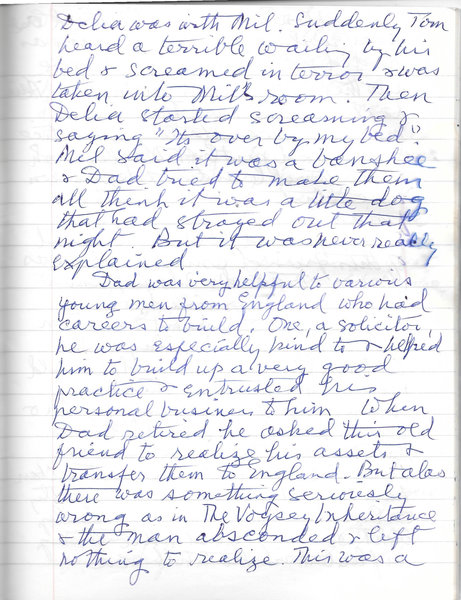
Once when she & Dad & the children were on holiday in Ireland staying in a vicarage Tom was in a room by himself,
Page 18
Delia was with Mil. Suddenly Tom heard a terrible wailing in his bed & screamed in terror & was taken into Mil’s room. Then Delia started screaming & saying “It’s over by my bed.” Mil said it was a banshee & Dad tried to make them all think it was a little dog that had strayed out that night. But it was never really explained.
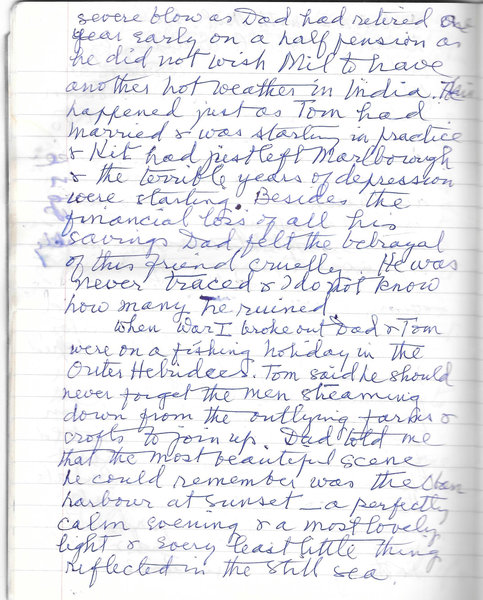
Dad was very helpful to various young men from England who had careers to build. One, a solicitor, he was especially kind to & helped him to build up a very good practice & entrusted his personal business to him. When Dad retired he asked this old friend to realise his assets & transfer them to England. But alas there was something seriously wrong as in The Voyager Inheritance & the man absconded & left nothing to realise. This was a
Page 19
severe blow as Dad had retired a year early on a half pension as he did not wish Mil to have another hot weather in India. This happened just as Tom had married & was starting in practice & Kit had just left Marlborough & the terrible years of depression were starting. Besides the financial loss of all his savings Dad felt the betrayal of this friend cruelly. He was never traced & I do not know how many he ruined.
When War I broke out Dad & Tom were on a fishing holiday in the Outer Hebrides. Tom said he should never forget the men streaming down from the outlying farms & crofts to join up. Dad told me that the most beautiful scene he could remember was the harbour at sunset — a perfectly calm evening & a most lovely light & every least little thing reflected in the still sea.
Page 20
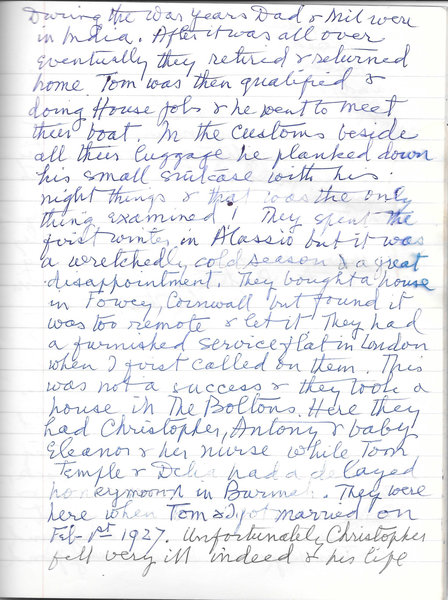
During the War years Dad & Mil were in India. After it was all over eventually they retired & returned home. Tom was then qualified & doing House jobs & he went to meet their boat. In the customs beside all their luggage he planked down his small suitcase with his night things & that was the only thing examined! They spent the first winter in Alassio but it was a wretchedly cold season & a great disappointment. They bought a house in Fowey, Cornwall but found it was too remote & let it. They had a furnished service flat in London when I first called on them. This was not a success & they took a house in The Boltons. Here they had Christopher, Antony & baby Eleanor & her nurse while Tom Temple & Delia had a delayed honeymoon in Burma. They were here when Tom & I got married on Feb 1st 1927. Unfortunately Christopher fell very ill indeed & his life
Page 21
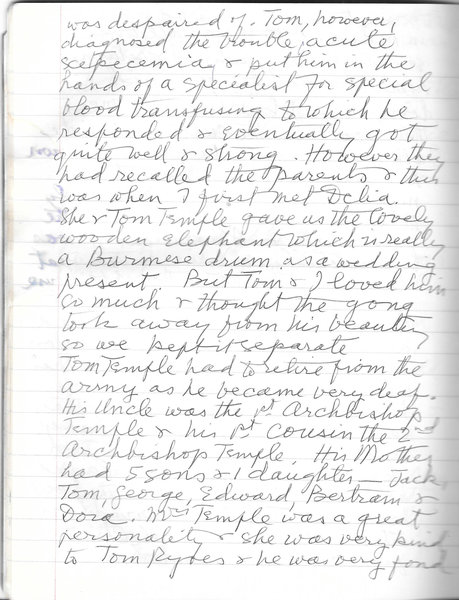
was despaired of. Tom, however, diagnosed the trouble, acute septicaemia, & put him in the hands of a specialist for special blood transfusing to which he responded & eventually got quite well & strong. However he had recalled the parents & this was when I first met Delia.
She & Tom Temple gave us the lovely wooden elephant which is really a Burmese drum as a wedding present. But Tom & I loved him so much & thought the gong took away from his beauty so we kept it separate.
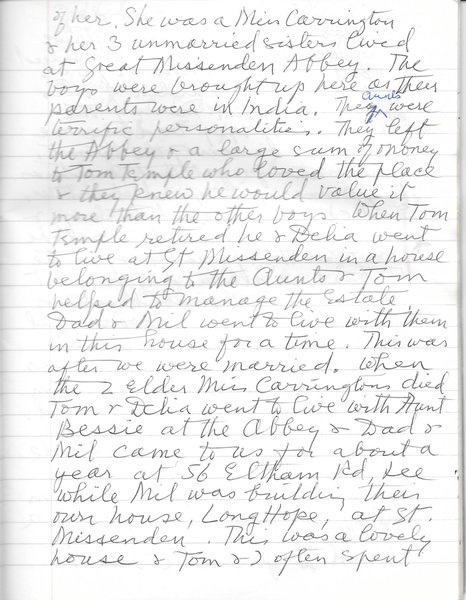
Tom Temple had to retire from the army as he became very deaf. His Uncle was the 1st Archbishop Temple & his 1st cousin the 2nd Archbishop Temple. His Mother had 5 sons & 1 daughter — Jack, Tom, George, Edward, Bertram & Dora. Mrs Temple was a great personality & she was very kind to Tom Ryves & he was very fond
Page 22
of her. She was a Miss Carrington & her 3 unmarried sisters lived at Great Missenden Abbey. The boys were brought up here as their parents were in India. These aunts were terrific personalities. They left the Abbey & a large sum of money to Tom Temple who loved the place & they knew he would value it more than the other boys. When Tom Temple retired he & Delia went to live at Gt Missenden in a house belonging to the Aunts & Tom helped to manage the estate.
Dad & Mil went to live with them in this house for a time. This was after we were married. When the 2 elder Miss Carringtons died Tom & Delia went to live with Aunt Bessie at the Abbey & Dad & Mil came to us for about a year at 56 Eltham Rd, Lee while Mil was building their new house, Longhope, at Gt Missenden. This was a lovely house & Tom & I often spent
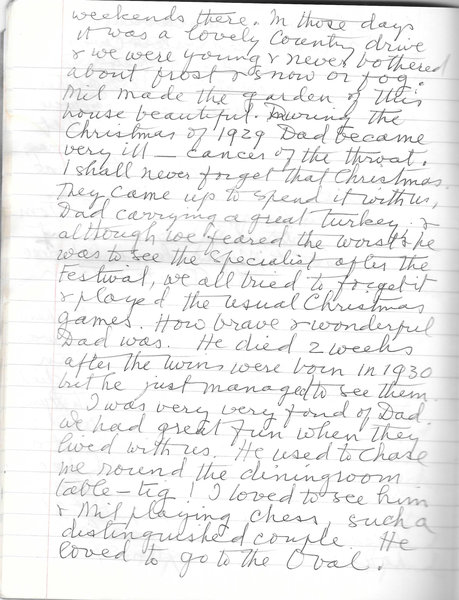
Page 23
weekends there. In those days it was a lovely country drive & we were young & never bothered about jobs to do now or fog!
Mil made the garden of this house beautiful. During the Christmas of 1929 Dad became very ill — cancer of the throat. I shall never forget that Christmas. They came up to spend it with us, Dad carrying a great turkey, & although we feared the worst & he was to see the specialist after the Festival, we all tried to forget it & played the usual Christmas games. How brave & wonderful Dad was. He died 2 weeks after the twins were born in 1930 but he just managed to see them.
I was very very fond of Dad. We had great fun when they lived with us. He used to chase me round the diningroom table — tag! I loved to see him & Mil playing chess, such a distinguished couple. He loved to go to the Oval!
Page 24
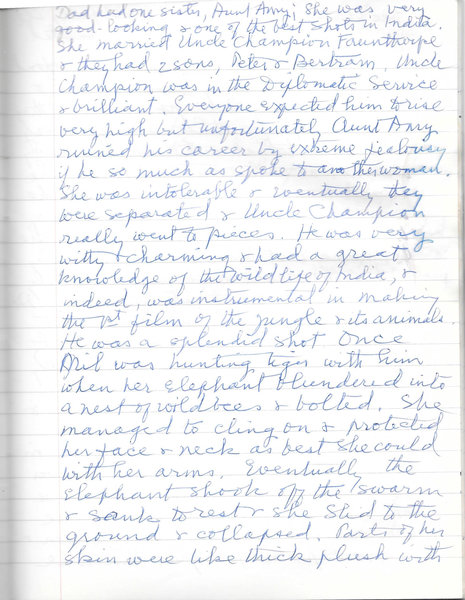
Dad had one sister, Aunt Amy. She was very good-looking & one of the best shots in Malta. She married Uncle Champion Faunthorpe & they had 2 sons, Peter & Bertram. Uncle Champion was in the Diplomatic Service & brilliant. Everyone expected him to rise very high but unfortunately Aunt Amy ruined his career by extreme jealousy if he so much as spoke to another woman. She was intolerable & eventually they were separated & Uncle Champion really went to pieces. He was very witty & charming & had a great knowledge of the wild life of India, & indeed, was instrumental in making the 1st film of the jungle & its animals. He was a splendid shot. Once Mil was hunting tiger with him when her elephant blundered into a nest of wild bees & bolted. She managed to cling on & protect her face & neck as best she could with her arms. Eventually the elephant shook off the swarm & sank to rest & she slid to the ground & collapsed. Parts of her skin were like thick plush with
Page 25
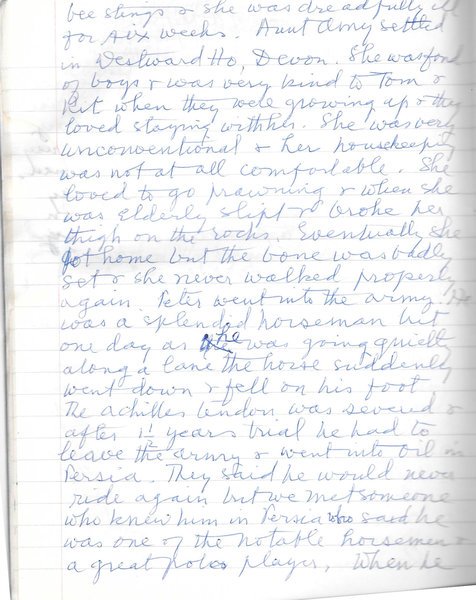
bee stings & she was dreadfully ill for six weeks. Aunt Amy settled in Westward Ho, Devon. She was fond of boys & was very kind to Tom & Kit when they were growing up & they loved staying with her. She was very unconventional & her housekeeping was not at all comfortable. She loved to go prawning & when she was elderly slipped & broke her thigh on the rocks. Eventually she got home but the bone was badly set & she never walked properly again.
Peter went into the army & was a splendid horseman but one day as he was going quietly along a lane the horse suddenly went down & fell on his foot. The achilles tendon was severed & after 1½ years trial he had to leave the army & went into oil in Persia. They said he would never ride again but we met someone who knew him in Persia who said he was one of the notable horsemen & a great polo player. When he
Page 26
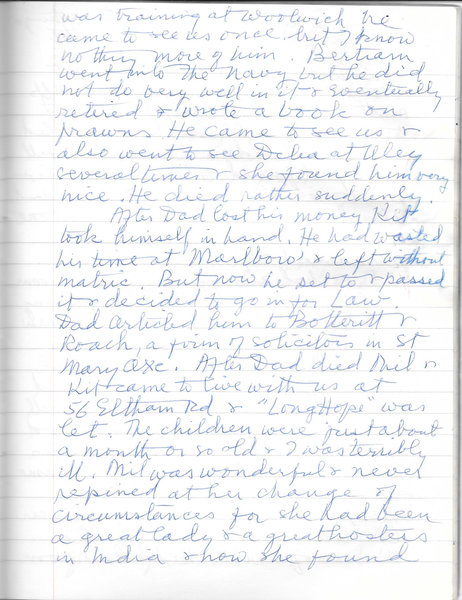
was training at Woolwich he came to see us once, but I know nothing more of him. Bertram went into the navy but he did not do very well in it & eventually retired & wrote a book on prawns. He came to see us & also went to see Delia at Illey several times & she found him very nice. He died rather suddenly.
After Dad lost his money, Kit took himself in hand. He had wasted his time at Marlboro’ & left without matric. But now he set to & passed it & decided to go in for Law. Dad articled him to Botterill & Roche, a firm of solicitors in St Mary Axe. After Dad died Mil & Kit came to live with us at 56 Eltham Rd & “Longhope” was let. The children were just about a month or so old & I was terribly ill. Mil was wonderful & never repined at her change of circumstances for she had been a great lady & a great hostess in India & now she found
Page 27
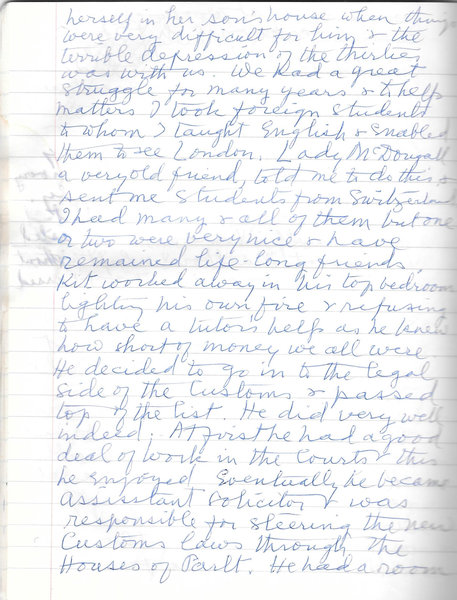
herself in her son’s house when things were very difficult for him & the terrible depression of the thirties was with us. We had a great struggle for many years & I helped matters. I took foreign students to whom I taught English & enabled them to see London. Lady McDougal, a very old friend, told me to do this & sent me students from Switzerland. I had many & all of them but one or two were very nice & have remained life-long friends.
Kit worked away in his top bedroom lighting his own fire & refusing to have a tutor’s help as he knew how short of money we all were. He decided to go in to the legal side of the Customs & passed top of the list. He did very well indeed; at first he had a good deal of work in the Courts & this he enjoyed. Eventually he became Assistant Solicitor & was responsible for steering the new Customs laws through the Houses of Parl. He had a room
Page 28
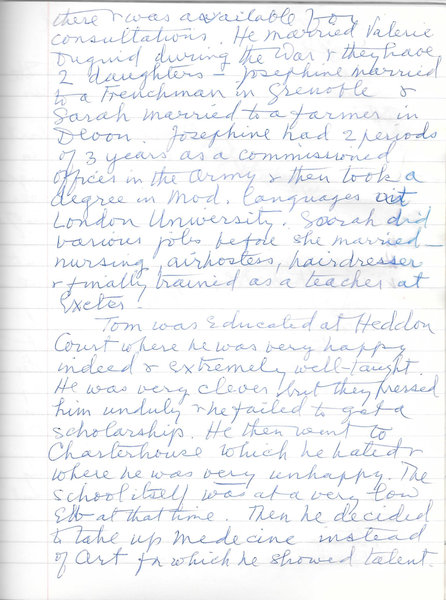
there & was available for consultations. He married Valerie Duguid during the War & they have 2 daughters — Josephine married to a Frenchman in Grenoble & Sarah married to a farmer in Devon. Josephine had 2 periods of 3 years as a commissioned officer in the army & then took a degree in mod. languages at London University. Sarah did various jobs before she married — nursing, air hostess, hairdresser & finally trained as a teacher at Exeter.
Tom was educated at Heddon Court where he was very happy indeed & extremely well-taught. He was very clever but they pressed him unduly & he failed to get a scholarship. He then went to Charterhouse which he hated & where he was very unhappy. The school itself was at a very low ebb at that time. Then he decided to take up medicine instead of Art for which he showed talent.
Page 29
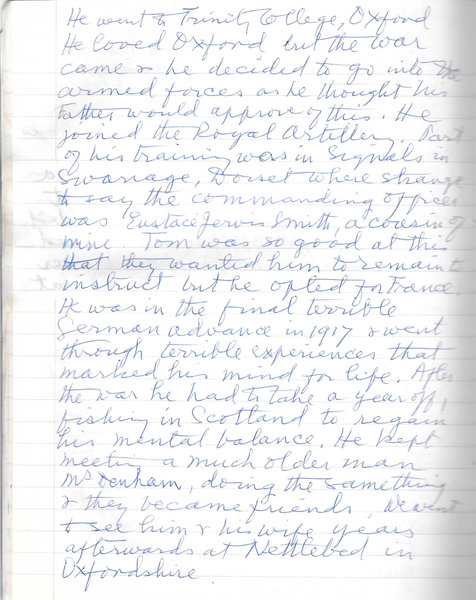
He went to Trinity College, Oxford. He loved Oxford, but the war came & he decided to go into the armed forces as he thought his father would approve of this. He joined the Royal Artillery. Part of his training was in signals in Swanage, Dorset where strange to say the commanding officer was Eustace Jervis Smith, a cousin of mine. Tom was so good at this that they wanted him to remain as instructor but he opted for France. He was in the final terrible German advance in 1917 & went through terrible experiences that marked his mind for life. After the war he had to take a year off fishing in Scotland to regain his mental balance. He kept meeting a much older man Mr Denham, doing the same thing & they became friends. We went to see him & his wife years afterwards at Nettlebed in Oxfordshire.
Page 30
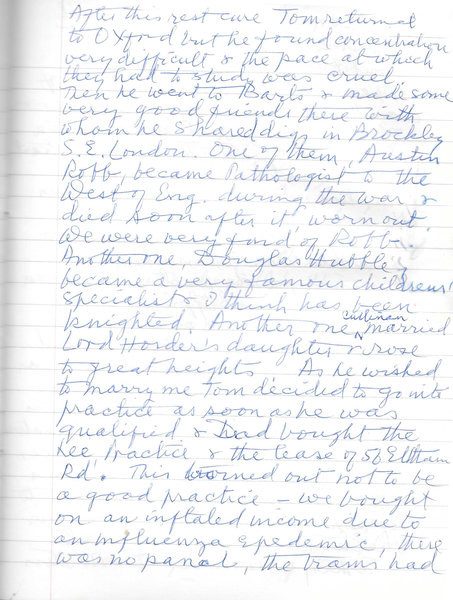
After this rest cure Tom returned to Oxford but he found concentration very difficult & the pace at which they had to study was cruel. Then he went to Bart’s & made some very good friends there with whom he shared digs in Brockley S.E. London. One of them, Austin Robb, became Pathologist to the West of Eng. during the war & died soon after it worn out. We were very fond of Robb. Another one, Douglas Hubble, became a very famous children’s specialist & I think has been knighted. Another one, William, married Lord Horder’s daughter & rose to great heights. As he wished to marry me Tom decided to go into practice as soon as he was qualified & Dad bought the Lee practice & the lease of 56 Eltham Rd. This turned out not to be a good practice — we bought on an inflated income due to an influenza epidemic; there was no panel, the trams had
Page 31
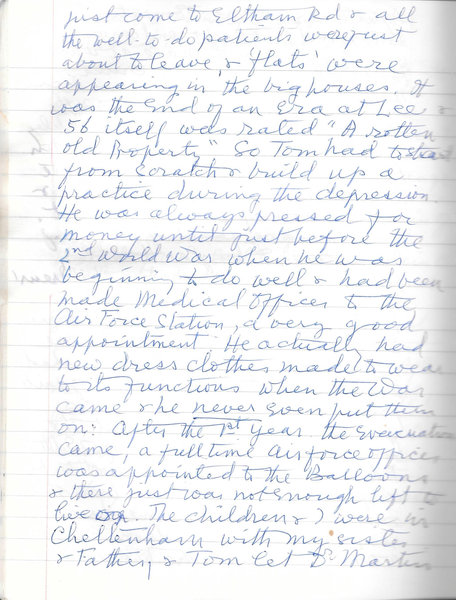
just come to Eltham Rd & all the well-to-do patients were just about to leave, & flats were appearing in the big houses. It was the end of an era at Lee. 56 itself was rated “A rotten old property.” So Tom had to start from scratch & build up a practice during the depression. He was always pressed for money until just before the 2nd World War when he was beginning to do well & had been made Medical Officer to the Air Force Station, a very good appointment. He actually had new dress clothes made to wear to its functions when the War came & he never even put them on. After the 1st year the evacuation came, a fulltime Air Force office was appointed to the Balloon & there just was not enough left to live on. The children & I were in Cheltenham with my sister & Father, & Tom let Dr Martin
Page 32
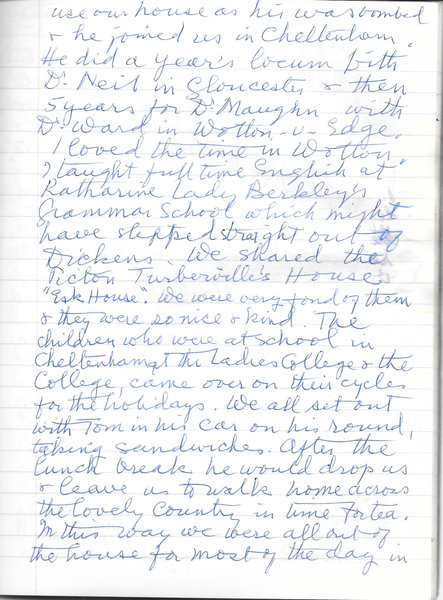
use our house as his was bombed & he joined us in Cheltenham. He did a year’s locum with Dr Neil in Gloucester & then 5 years for Dr Maughan with Dr Ward in Wotton-u-Edge. I loved the time in Wotton. I taught full time English at Katharine Lady Berkeley’s Grammar School which might have stepped straight out of Dickens. We shared the Rector Timberville’s House “Esk House”. We were very fond of them & they were so nice & kind. The children who were at school in Cheltenham at the Ladies College & the College came over on their cycles for the holidays. We all set out with Tom in his car on his round, taking sandwiches. After the lunch break he would drop us & leave us to walk home across the lovely country in time for tea. In this way we were all out of the house for most of the day in
Page 33
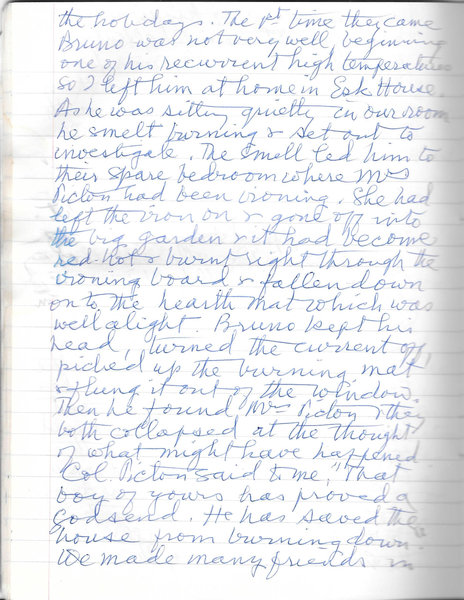
the holidays. The 1st time they came Bruno was not very well, beginning one of his recurrent high temperatures so I left him at home in Esk House. As he was sitting quietly in our room he smelt burning & set out to investigate. The smell led him to their spare bedroom where Mrs Picton had been ironing. She had left the iron on & gone off into the big garden & it had become red-hot & burnt right through the ironing board & fallen down onto the hearth mat which was well alight. Bruno kept his head, turned the current off, picked up the burning mat & flung it out of the window. Then he found Mrs Picton & they both collapsed at the thought of what might have happened. Col. Picton said to me, “That boy of yours has proved a godsend. He has saved the house from burning down.”
We made many friends in
Page 34
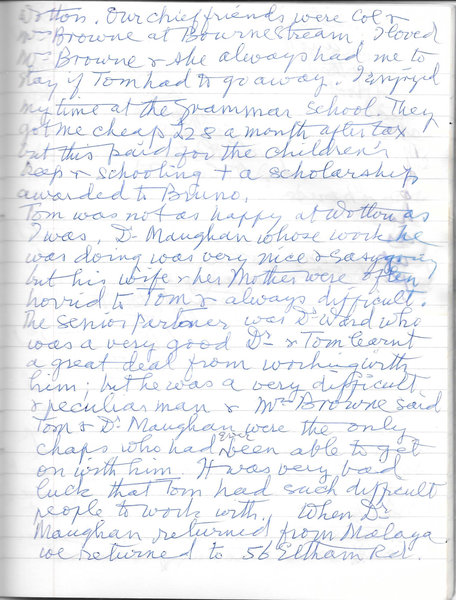
Wotton. Our chief friends were Col. & Mrs Browne at Bourne Stream. I loved Mrs Browne & she always had me to stay if Tom had to go away. I enjoyed my time at the Grammar School. They got me cheap, £28 a month after tax, but this paid for the children’s keep & schooling & a scholarship awarded to Bruno.
Tom was not as happy at Wotton as I was. Dr Maughan whose work he was doing was very nice & sanguine but his wife & her Mother were often horrid to Tom & always difficult. The senior partner was Dr Ward who was a very good Dr & Tom learnt a great deal from working with him, but he was a very difficult & peculiar man & Mrs Browne said Tom & Dr Maughan were the only chaps who had been able to get on with him. It was very bad luck that Tom had such difficult people to work with. When Dr Maughan returned from Malaya we returned to 56 Eltham Rd
Page 35
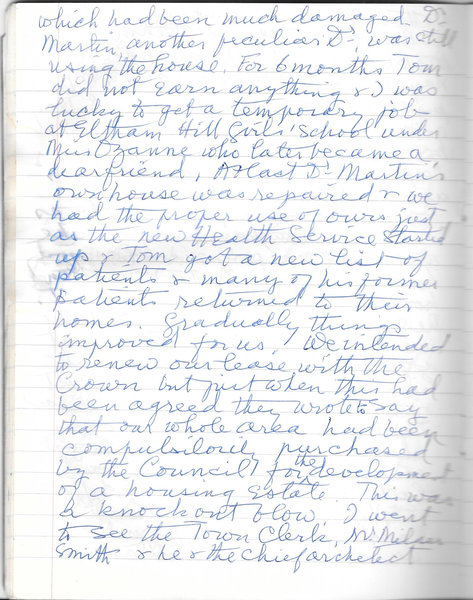
which had been much damaged. Dr Martin, another peculiar Dr, was still using the house. For 6 months Tom did not earn anything & I was lucky to get a temporary job at Eltham Hill Girls’ School under Miss Ozanne who later became a dear friend. At last Dr Martin’s own house was repaired & we had the free use of ours just as the new Health Service started up & Tom got a new list of patients & many of his former patients returned to their homes. Gradually things improved for us. We intended to renew our lease with the Crown but just when this had been agreed they wrote to say that our whole area had been compulsorily purchased by the Council for the development of a housing estate. This was a knockout blow. I went to see the Town Clerk, Mr Smith & he & the chief architect
Page 36
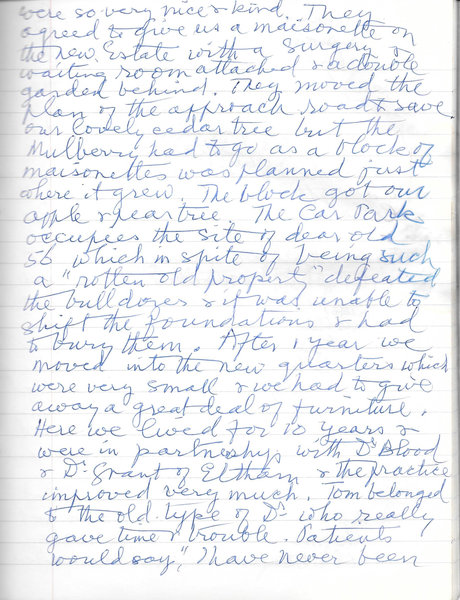
were so very nice & kind. They agreed to give us a maisonette on the new estate with a surgery & waiting room attached & a double garden behind. They moved the plan of the approach road to save our lovely cedar tree but the Mulberry had to go as a block of maisonettes was planned just where it grew. The block got our apple & pear tree. The Car Park occupies the site of dear old 56 which in spite of being such a “rotten old property” defeated the bulldozers & it was unable to shift the foundations & had to bury them. After 1 year we moved into the new quarters which were very small & we had to give away a great deal of furniture. Here we lived for 10 years & were in partnership with Dr Blood & Dr Grant of Eltham & the practice improved very much. Tom belonged to the old type of Dr who really gave time & trouble. Patients would say, “I have never been
Page 37
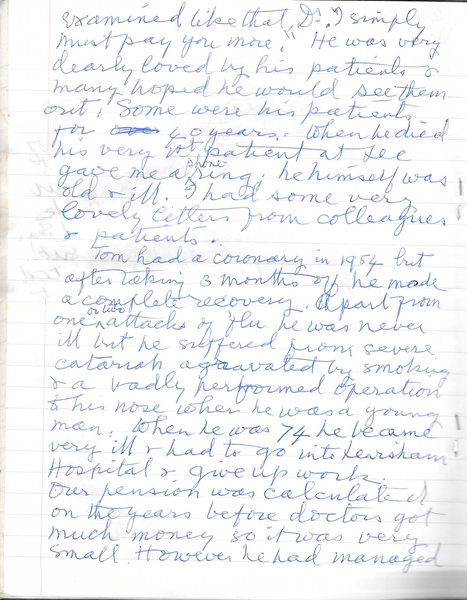
examined like that, Dr. I simply must pay you more.” He was very dearly loved by his patients & many hoped he would see them out! Some were his patients for over 40 years. When he died his very 1st patient at Lee gave me a phone ring. He himself was old & ill. I had some very lovely letters from colleagues & patients.
Tom had a coronary in 1954 but after taking 3 months off he made a complete recovery. Apart from one or two attacks of flu he was never ill but he suffered from severe catarrh aggravated by smoking & a badly performed operation to his nose when he was a young man. When he was 74 he became very ill & had to go into Lewisham Hospital & give up work. Our pension was calculated on the years before doctors got much money so it was very small. However he had managed
Page 38
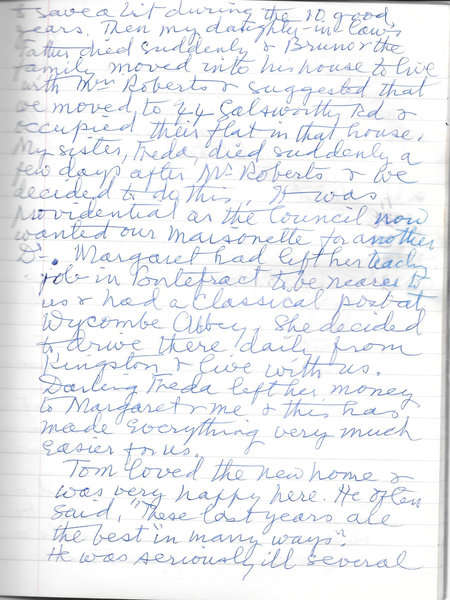
save a bit during the 10 good years. Then my daughter-in-law’s father died suddenly & Bruno & the family moved into his house to live with Mrs Roberts & suggested that we moved to 94 Salsbury Rd & occupied their flat in that house.
My sister Freda died suddenly a few days after Mrs Roberts & we decided to do this. It was providential as the Council now wanted our maisonette for another Dr. Margaret had left her teaching job in Tonbridge to be nearer to us & had a classical post at Wycombe Abbey. She decided to drive there daily from Kingston & live with us. Darling Freda left her money to Margaret & me & this has made everything very much easier for us.
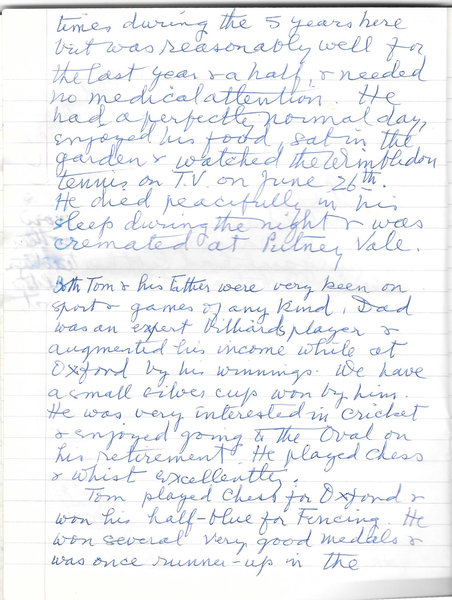
Tom loved the new house & was very happy here. He often said, “These last years are the best in many ways.” He was seriously ill several
Page 39
times during the 5 years here but was reasonably well for the last year & a half & needed no medical attention. He had a perfectly normal day, enjoyed his food, sat in the garden & watched the Wimbledon tennis on T.V. on June 26th. He died peacefully in his sleep during the night & was cremated at Elmer Vale.
Both Tom & his Father were very keen on sport & games of any kind. Dad was an expert billiards player & augmented his income while at Oxford by his winnings. We have a small silver cup won by him. He was very interested in cricket & enjoyed going to the Oval on his retirement. He played chess & whist excellently.
Tom played chess for Oxford & won his half-blue for Fencing. He won several very good medals & was once runner-up in the
Page 40
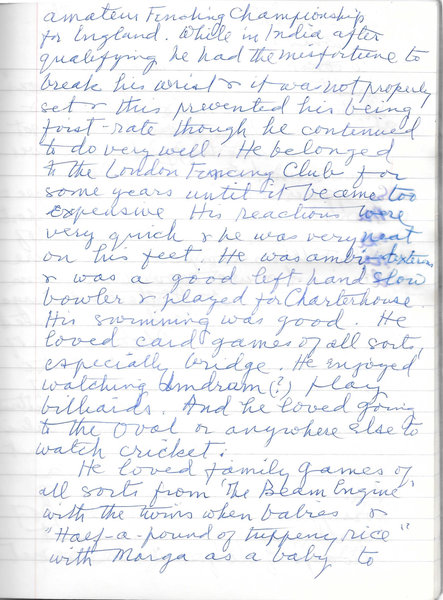
amateur Fencing Championship for England. While in India after qualifying he had the misfortune to break his wrist & it was not properly set & this prevented his being first-rate though he continued to do very well. He belonged to the London Fencing Club for some years until it became too expensive. His reactions were very quick & he was very neat on his feet. He was ambidextrous & was a good left hand slow bowler & played for Charterhouse. His swimming was good. He loved card games of all sorts especially bridge. He enjoyed watching Snooker (?) & playing billiards. And he loved going to the Oval or anywhere else to watch cricket.
He loved family games of all sorts from “The Bedlam Engine” with the twins when babies & “Half-a-pound of tuppenny rice” with Marga as a baby to
Page 41
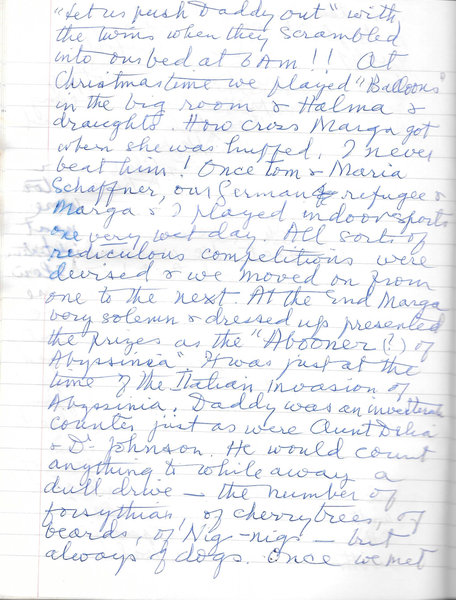
“Let us push Daddy out” with the twins when they scrambled into our bed at 8 am!! At Christmastime we played “Balloons” in the big room & Halma & draughts. How cross Marga got when she was buffeted. I never beat him! Once Tom & Maria Schaffner, our German refugee, & Marga & I played indoor short one very wet day. All sorts of ridiculous competitions were devised & we moved on from one to the next. At the end Marga very solemn & dressed up presented the prizes as the “Abboner (?) of Abyssinia”. It was just at the time of the Italian invasion of Abyssinia. Daddy was an inveterate counter just as were Aunt Delia & Dr Johnson. He would count anything & while away a dull drive — the number of forsythias, of cherry trees, of beards, of Nig-nigs — but always of dogs. Once we met
Page 42
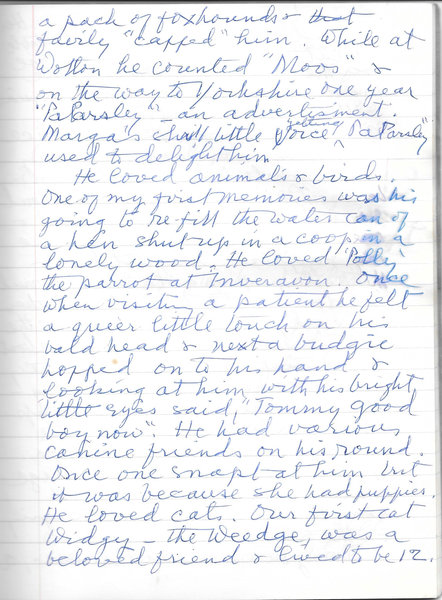
a pack of foxhounds & that fairly “capped” him. While at Wotton he counted “Mevos” & on the way to Yorkshire one year “Paparadleys” — an advertisement. Marga & I still little yelling “Paparadleys” used to delight him.
He loved animals & birds. One of my first memories was his going to re-fill the water can of a hen shut up in a coop in a lonely wood. He loved Polly the parrot at Inveravon. Once when visiting a patient he felt a queer little touch on his bald head & next a budgie hopped on to his hand & looking at him with his bright little eyes said, “Tommy good boy now.” He had various canine friends on his round. Once one snapped at him but it was because she had puppies. He loved cats. Our first cat Widgey — the Wedge — was a beloved friend & lived to be 12.
Page 43
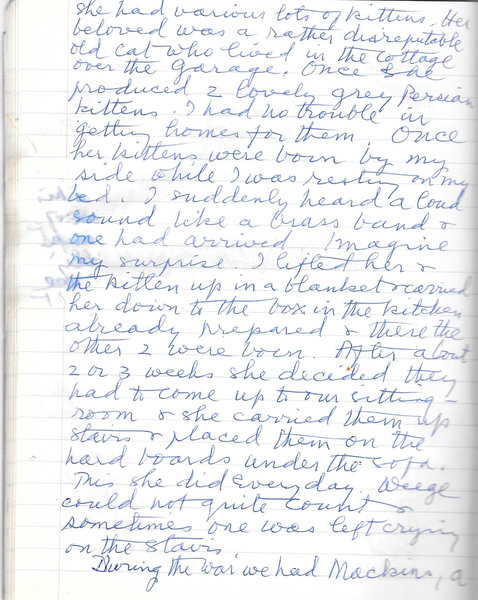
She had various lots of kittens. Her beloved was a rather disreputable old cat who lived in the cottage over the garage. Once she produced 2 lovely grey Persian kittens. I had no trouble in getting homes for them. Once her kittens were born by my side while I was resting on my bed. I suddenly heard a loud sound like a brass band & one had arrived. Imagine my surprise. I lifted her & the kitten up in a blanket & carried her down to the box in the kitchen already prepared & there the other 2 were born. After about 2 or 3 weeks she decided they had to come up to our sitting room & she carried them up stairs & placed them on the head boards under the sofa. This she did every day. We could not quite count & sometimes one was left crying on the stairs.
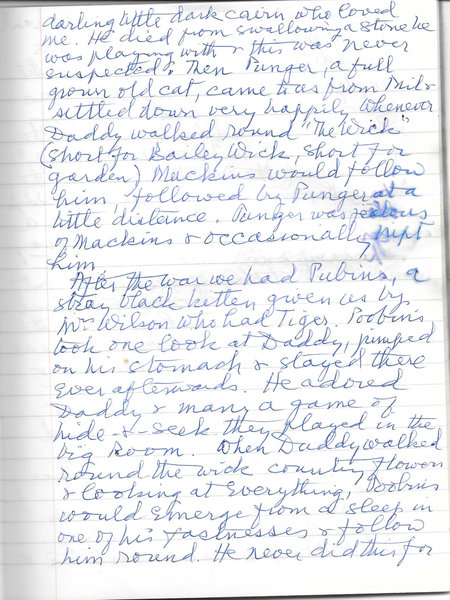
During the war we had Mackins,
Page 44
darling little dark cairn who loved me. He died from swallowing a stone he was playing with & this was never suspected. Then Pinger, a full grown old cat, came to us from Mil & settled down very happily whenever Daddy walked round “The Wicks” (short for Bailey Wick, short for garden). Mackins would follow him followed by Pinger at a little distance. Pinger was jealous of Mackins & occasionally nipped him.
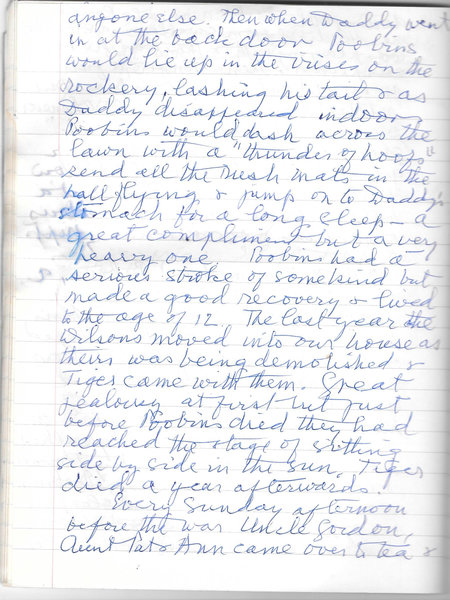
After the war we had Pobbins, a stray black kitten given us by Mrs Wilson who had Tiges. Pobbins took one look at Daddy, jumped on his stomach & stayed there ever afterwards. He adored Daddy & many a game of hide-&-seek they played in the big room. Often Daddy walked round the wild country flowers & looking at everything, Pobbins would emerge from a sleep in one of his fastnesses & follow him round. He never did this for
Page 45
anyone else. Then when Daddy went in at the back door Pobbins would lie up in the roses on the rockery, lashing his tail & as Daddy disappeared indoors Pobbins would dash across the lawn with a “thunder of hoofs”, send all the mesh mats in the hall flying & jump on to Daddy’s stomach for a long sleep — a great compliment but a very heavy one. Pobbins had a serious stroke of some kind but made a good recovery & lived to the age of 17. The last year the Wilsons moved into our house as theirs was being demolished & Tiges came with them. Great jealousy at first but just before Pobbins died they had reached the stage of sitting side by side in the sun. Tiges died a year afterwards.
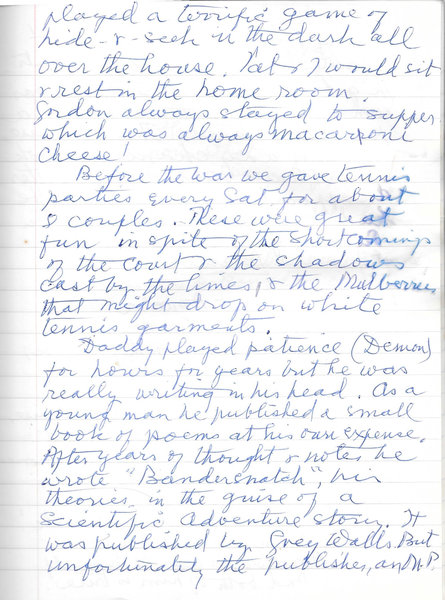
Every Sunday afternoon before the war Uncle Gordon, Aunt Pat & Ann came over to tea &
Page 46
played a terrific game of hide-&-seek in the dark all over the house. Pat & I would sit & rest in the home room. Gordon always stayed to supper, which was always Macaroni Cheese!
Before the war we gave tennis parties every Sat. for about 8 couples. These were great fun in spite of the shortening of the court & the shadows cast by the limes, & the Mulberries that might drop on white tennis garments.
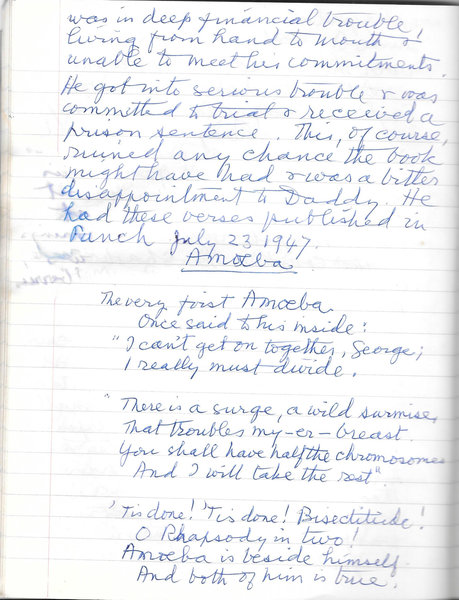
Daddy played patience (Demon) for hours for years but he was really writing in his head. As a young man he published a small book of poems at his own expense. After years of thought & notes he wrote “Bendirenatiah”, his theories in the guise of a scientific adventure story. It was published by Grey Walls. But unfortunately the publisher, a Mr
Page 47
was in deep financial trouble, living from hand to mouth & unable to meet his commitments. He got into serious trouble & was committed to trial & received a prison sentence. This, of course, ruined any chance the book might have had & was a bitter disappointment to Daddy. He had these verses published in Punch July 23 1947.
Amoeba
The very first Amoeba Once said to his inside: “I can’t get on together, George; I really must divide.”
“There is a surge, a wild surmise That troubles my-er-breast. You shall have half the chromosomes And I will take the rest.”
’Tis done! ’Tis done! Bisectitude! O Rhapsody in two! Amoeba is beside himself. And both of him is true.
Page 48
“Hail & farewell,” Amoeba said, “This is the day of days. We meet just once as pseudopods And take our parting ways.
“The centuries that lie ahead; Those flying years of grace! Who knows what we may yet become? We’ll set a pounding pace.
Amoeba’s road is hard & long To Nineveh & Rome, But still Amoeba’s on the grade. On, on, to kingdom come!
The very first Amoeba Is getting old & grey, But still his dreams are far ahead; His future far away.
Oh, not for him is history And human joy & pain In twenty minutes he’ll divide And then eat out again.
Page 49
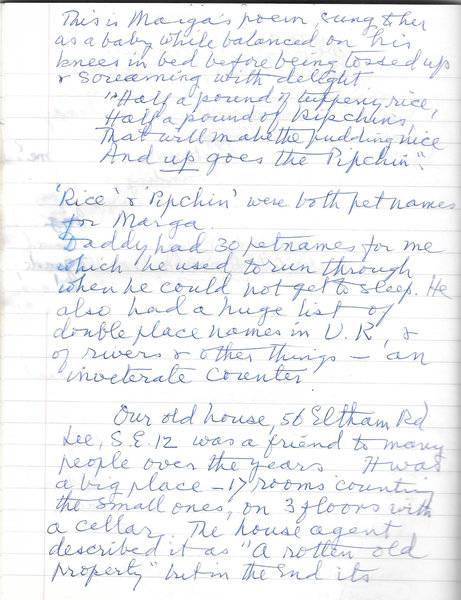
This is Marga’s poem sung to her as a baby while balanced on his knees in bed before being tossed up & screaming with delight.
“Half a pound of tuppenny rice, Half a pound of kipchins That will make the pudding nice And up goes the Pipchin.”
“Rice” & “Pipchin” were both pet names for Marga.
Daddy had 30 pet names for me which he used to run through when he could not get to sleep. He also had a huge list of double place names in U.K., & of rivers & other things — an inveterate counter.
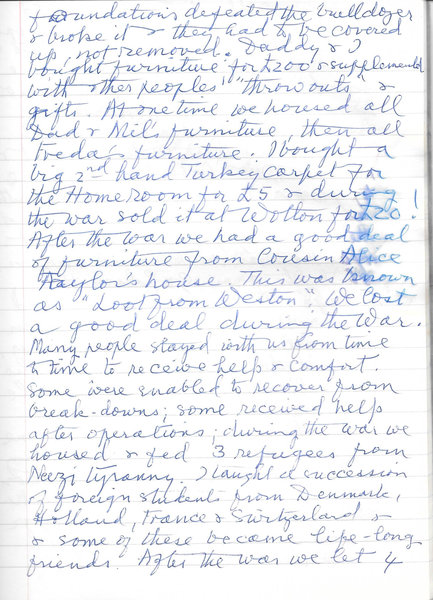
Our old house, 56 Eltham Rd Lee, S.E.12 was a friend to many people over the years. It was a big place — 17 rooms counting the small ones, on 3 floors with a cellar. The house agent described it as “a rotten old property” but in the end its
Page 50
foundations defeated the bulldozers & broke it & they had to be covered up, not removed. Daddy & I bought furniture for £200 & supplemented with other peoples’ “throw outs” & gifts. At one time we housed all Dad & Mil’s furniture, then all Freda’s furniture. I bought a big 2nd hand Turkey carpet for the Homeroom for £5 & during the war sold it at Wotton for £20!
After the war we had a good deal of furniture from Cousin Alice Taylor’s house. This was known as “Loot from Weston”. We lost a good deal during the war. Many people stayed with us from time to time to receive help & comfort. Some were enabled to recover from break-downs; some received help after operations; during the war we housed & fed 3 refugees from Nazi tyranny. I taught a succession of foreign students from Denmark, Holland, France & Switzerland & some of these became life-long friends. After the war we let 4
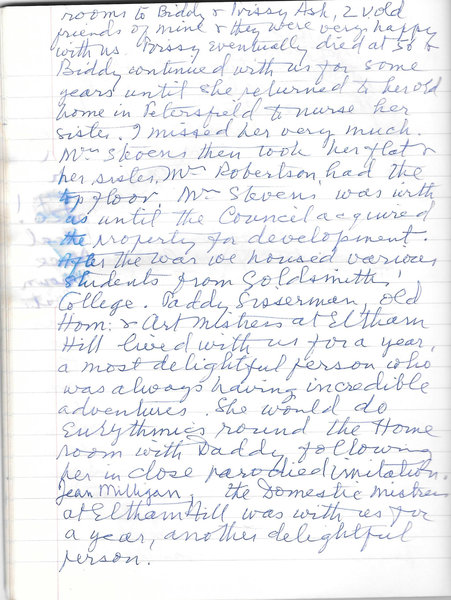
Page 51
rooms to Biddy & Missy Ash, 2 old friends of mine & they were very happy with us. Missy eventually died at 56 & Biddy continued with us for some years until she returned to her old home in Petersfield to nurse her sister. I missed her very much.
Mrs Stevens then took her flat & her sister, Mrs Robertson, had the top floor. Mrs Stevens was with us until the Council acquired the property for development.
After the war we housed various students from Goldsmiths’ College. Daddy’s Wiseman, old Horn, & Art Misters at Eltham Hill lived with us for a year, a most delightful person who was always having incredible adventures. She would do Eurhythmics round the Homeroom with Daddy, following her in close, paralysed imitation. Jean Milligan, the Domestic Mistress at Eltham Hill was with us for a year, another delightful person.
Page 52
Mil loved coming to stay with us & she was so very fond of our beautiful garden.
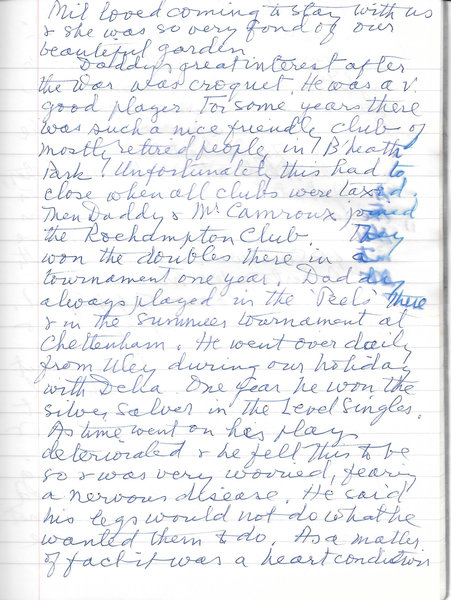
Daddy’s great interest after the war was croquet. He was a very good player. For some years there was such a nice friendly club of mostly retired people in Blackheath Park. Unfortunately this had to close when all clubs were taxed. Then Daddy & Mr Camproux joined the Roehampton Club. They won the doubles there in a tournament one year. Daddy always played in the “Peels” there & in the summer tournament at Cheltenham. He went over daily from Illey during our holiday with Delia. One year he won the silver salver in the Level Singles. As time went on his play deteriorated & he felt this to be so & was very worried, fearing a nervous disease. He said his legs would not do what he wanted them to do. As a matter of fact it was a heart condition
Page 53
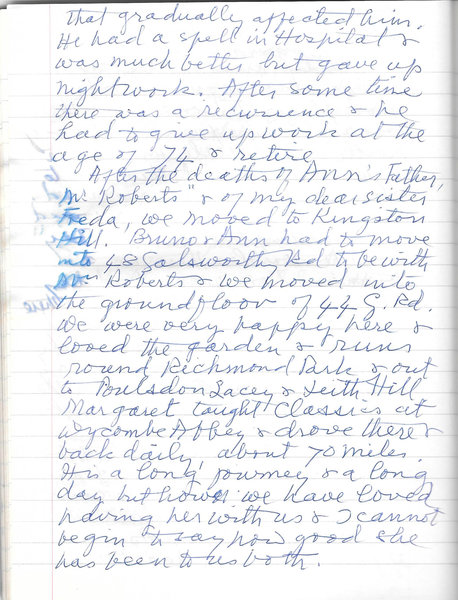
that gradually affected him. He had a spell in Hospital & was much better but gave up night work. After some time there was a recurrence & he had to give up work at the age of 74 & retire.
After the deaths of Ann’s Father, Mr Roberts, & of my dear sister Freda, we moved to Kingston Hill. Bruno & Ann had to move into 48 Salsbury Rd to be with Mrs Roberts & we moved into the ground floor of 44 S. Rd. We were very happy here & loved the garden & runs round Richmond Park & out to Wimbledon races & Reigate Hill. Margaret taught Classics at Wycombe Abbey & drove there & back daily, about 70 miles. It is a long journey & a long day but how we have loved having her with us & I cannot begin to say how good she has been to us both.
Page 54
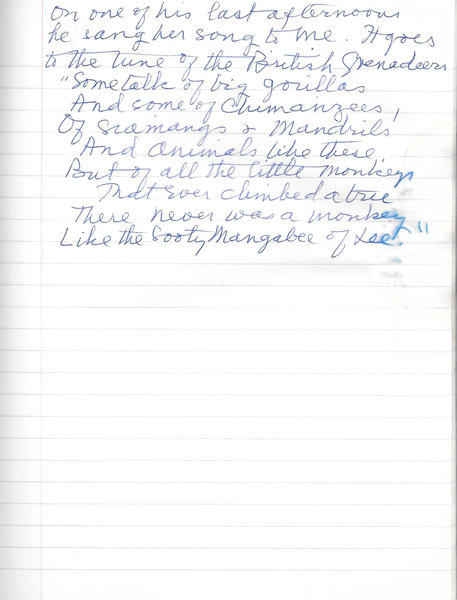
On one of his last afternoons he sang her song to me. It goes to the tune of the British Grenadiers.
“Some talk of big gorillas And some of chimpanzees, Of orangs & Mandrills And animals like these. But of all the little monkeys That ever climbed a tree There never was a monkey Like the Sooty Mangabee of Lee!”